Article
3 Ways Executives Can Stay Ahead of Wildfire Risk
Just knowing your service area’s wildfire risk is not enough anymore.
Wildfire risk has moved to the top of the agenda for electric utility executives across the country. The liability exposure is real, the regulatory expectations are rising, and the financial consequences of an asset-caused ignition have been made visible in ways that are difficult to ignore. For many executives, the challenge is not recognizing the risk. It is knowing where to focus and how to demonstrate that the organization is managing it with the rigor that insurers, credit agencies, regulators, and boards are now expecting.
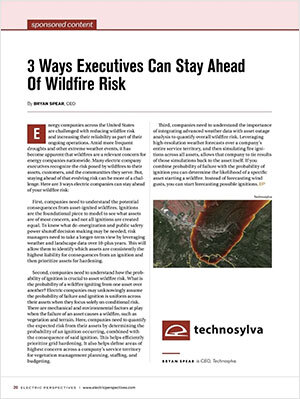
Technosylva CEO Bryan Spear addressed this directly in a piece for Electric Perspectives Magazine, laying out three ways electric company executives can move from a reactive posture to one that is genuinely ahead of their wildfire exposure. The argument is straightforward: wildfire risk is not like other natural hazard risks, and managing it well requires a different kind of analytical foundation.
Why Wildfire Risk Is Different
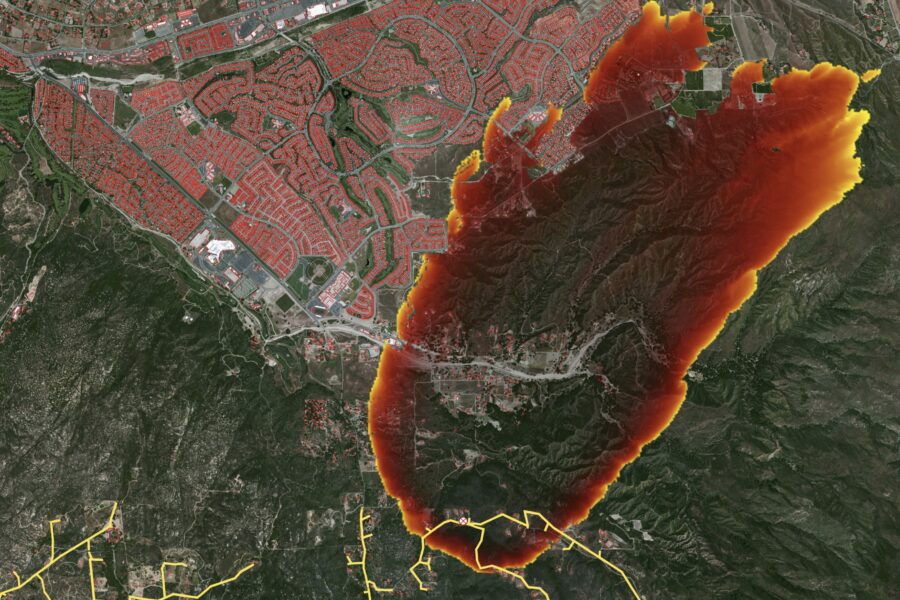
For most natural hazards, utility risk management focuses on outage restoration and revenue impact. The models are relatively well understood. Wildfire is different because the question is not just whether an outage will occur, but whether an asset failure will cause an ignition, and if it does, what the consequences of that ignition will be for communities, infrastructure, and the utility itself.
That combination of ignition probability and consequence is what makes wildfire risk genuinely complex to quantify, and what makes a generalized or static risk assessment insufficient for the conversations executives are now being asked to have with external stakeholders.
Three Ways to Get Ahead of It
The first is understanding the potential consequences of asset-ignited wildfires. As Bryan writes, ignitions are the foundational piece to model, and not all ignitions are created equal. To understand what de-energization and Public Safety Power Shutoff (PSPS) decision-making may be needed, risk managers need to take a longer-term view by leveraging weather and landscape data over ten or more years. That analysis identifies which assets are consistently the highest liability for consequences from an ignition, and allows executives to prioritize those assets for hardening based on actual potential impact rather than general proximity to risk.
The second is understanding how ignition probability varies across the asset base. Electric companies may unknowingly assume that the probability of failure and ignition is uniform across their assets when they focus solely on conditional risk. In reality, as Bryan notes, there are mechanical and environmental factors at play when the failure of an asset causes a wildfire, including vegetation and terrain. Quantifying the expected risk from assets by combining the probability of an ignition occurring with the consequence of that ignition helps efficiently prioritize grid hardening. It also defines areas of highest concern across a service territory for vegetation management planning, staffing, and budgeting.
The third is integrating advanced weather data with asset outage analysis to build a comprehensive view of overall wildfire risk. By leveraging high-resolution weather forecasts across the entire service territory and simulating fire ignitions across all assets, an organization can tie the results of those simulations back to the asset itself. As Bryan puts it: if you combine probability of failure with the probability of ignition, you can determine the likelihood of a specific asset starting a wildfire. Instead of forecasting wind gusts, you can start forecasting possible ignitions.
What This Means for Executives at Any Size Utility
The three capabilities Bryan describes are relevant for utility executives regardless of the size of their organization. A catastrophic asset-caused ignition carries existential consequences for a small cooperative or municipal utility just as it does for a large investor-owned utility. The financial exposure, the regulatory scrutiny, and the community impact do not scale down with the size of the organization.
What does vary is the internal analytical capacity to build and maintain this kind of modeling framework. The regulatory and financial expectations Bryan describes apply across utility sizes, and the path to meeting them looks different depending on the organization.
The executives best positioned to manage wildfire risk going forward are not necessarily the ones with the largest budgets. They are the ones who understand their specific exposure at the asset level, can quantify the consequences of their highest-risk ignition scenarios, and can communicate that understanding clearly to the stakeholders who are asking.
Read Bryan’s full piece in Electric Perspectives Magazine for the complete argument.
Related Posts