-
The Risk Landscape is Changing for Electric Utilities

Wildfire is no longer a regional issue. It is a national challenge that is reshaping how electric utilities think about risk.
The Big Picture
Wildfire, once perceived as a California problem, has become a nationwide concern for electric utilities, driven by escalating liability, growing regulatory demands, and investor scrutiny.
The 2023 Lahaina Fire served as a stark wake-up call, forcing electric utilities across the country to confront the financial and operational reality of wildfire exposure. Several catastrophic and deadly fires have followed.
Wildfire risk now looms as a top-tier threat capable of severely impacting electric utilities with little warning. This shift calls for a fundamental reconsideration of risk management strategies, from improved modeling to proactive mitigation.
What’s Changing, Fast
Liability Risk is Spreading
The Lahaina Fire tragedy illustrated that catastrophic wildfire risk extends far beyond traditional high-risk regions. Hawaiian Electric’s rapid market cap decline and subsequent large settlement underscore the potential for devastating financial repercussions, regardless of perceived culpability. Even in states where liability caps are being considered, those protections come with substantial expectations that utilities do everything in their power to manage fire risk. The 2024 Smokehouse Creek Fire further solidified the reality that no region and no electric utility is immune from the consequences of asset-caused wildfire ignitions.
Investors, Creditors, and Insurance are Questioning Their Support and Demanding Change
Electric utilities are grappling with uncapped liability, a concern amplified by Warren Buffett’s public questioning of the industry’s investment viability in 2024. Investor confidence is directly tied to a utility’s ability to demonstrate robust wildfire risk management. Credit rating agencies are scrutinizing wildfire risk management practices and are actively downgrading utilities without adequate systems in place. Insurance availability and affordability have become critical challenges, with many electric utilities facing difficulty securing coverage or resorting to self-insurance.
Regulatory and Stakeholder Pressures Are Growing
States outside of California are increasingly implementing stringent regulatory compliance requirements, including mandated wildfire mitigation plans. Shareholders, local governments, regulators, community members, and insurers are all demanding that utilities employ proactive wildfire mitigation measures for improved decision-making.
How Electric Utilities Can Respond
Electric utility risk managers are no longer facing a theoretical threat. Wildfire risk, once considered a localized issue, has become a pervasive and financially consequential hazard.
The core challenge is accurately understanding and quantifying a dynamic, complex, and previously underestimated risk. This is not just about modeling fire behavior. It is about translating that knowledge into actionable mitigation strategies and operational decision-making that address liability, regulatory compliance, investor confidence, and stakeholder trust.
The path forward involves moving from reactive to proactive, from generalized risk assessments to granular, defensible strategies, and ensuring long-term financial stability and operational resilience in the face of an increasingly volatile environment.
What Is Next: Embrace Proactive Risk Management
By leveraging sophisticated tools for real-time monitoring, predictive analytics, and granular consequence modeling, electric utilities can move beyond reactive measures and static assessments.
Electric utilities can advance risk reduction with more data-driven decision-making across all facets of the organization. For daily operations, this translates to optimized resource allocation, proactive mitigation efforts in high-risk zones, and more informed decisions regarding Public Safety Power Shutoffs. For long-term asset planning, a clear understanding of wildfire consequence enables utilities to strategically prioritize infrastructure hardening and investments.

-
Your Guide to Wildfire Risk and Liability Exposure
This webinar discusses understanding current trends in wildfire behavior and their implications on risk and liability exposure, along with methodologies for risk assessment, mitigation strategies, and tools for real-time monitoring and response to wildfire threats.
Duration: 1 hour
This informative webinar, in collaboration with Utility Dive, explores the tactics utilized by leading electric utilities to forecast, mitigate, and respond to wildfire risks and the associated liability.
As wildfires continue to increase in frequency and severity, they present a significant threat to electric utilities infrastructure and communities. Electric utilities face a risk stemming from their infrastructure to trigger wildfires and the liabilities that come with that.
Electric utilities can adopt proactive measures, such as preemptive power shutdowns to minimize the risk of wildfires and safeguard the areas in their service territory as well as using solutions that can help assess assets for mitigation purposes.
During the session, you will learn from Technosylva:
- Insights into the latest trends and patterns in wildfire behavior, and their implications for risk and liability exposure
- Methodologies for assessing wildfire risk and strategies for implementing effective mitigation measures
- Tools and techniques for real-time monitoring and response to wildfire threats
Speakers
David Buckley
Board Advisor
TechnosylvaScott Purdy
Meteorological Analyst
Technosylva -
The PSPS Paradigm Shift

“The lights may go out by design, but the mission has never been clearer: keeping communities safe through decisive operational decision-making.”
Picture this scenario: At 2:47 AM on a wind-whipped October morning, an electric utility meteorologist stares at forecast models with growing unease. What had been predicted as manageable 35 mph winds twelve hours earlier now shows catastrophic potential: sustained winds of 45 mph with gusts reaching 70. In twelve hours, the electric utility might need to make a decision that would have been unthinkable just five years ago: intentionally cutting power for up to 50,000 customers in order to prevent a high-probability catastrophic wildfire.
For electric utilities in wildfire-risk areas nationwide, this scenario represents the new reality of operations. Public Safety Power Shutoffs (PSPS), once a radical concept, have rapidly evolved into the new standard of care. Today, regulators don’t just expect electric utilities to have PSPS programs: they consider it negligent not to have them, even if they’re rarely used.
This requires electric utilities to embrace a fundamental change in mindset, from “we will never turn off the power” to “we will do everything in our power to create a safe community, and minimize the impact of PSPS if it needs to be used.” This comes with a change in operational approach, which requires data, precision and communication to approach PSPS surgically: only when necessary and only where necessary.
The Sprint Against Time
Unlike traditional electric utility operations that can unfold over days or weeks, PSPS decisions happen in a compressed timeframe that leaves no room for hesitation. Electric utilities have maybe 48 to 72 hours from the moment they can forecast high-risk conditions to the moment they need to notify customers. In that window, they’re analyzing thousands of assets, running risk calculations on hundreds of circuits, and making decisions that affect tens of thousands of lives.
This isn’t leisurely analysis: it’s a sprint requiring immediate action and coordinated responses. The process has evolved dramatically since those early days of broad shutoffs, with electric utilities developing increasingly precise approaches to minimize customer impacts while maintaining safety.
But this precision comes at a cost: the need for split-second decision-making under enormous pressure.
The Meteorologist’s Critical Role
In this new paradigm, electric utility meteorologists have become the first line of defense in wildfire prevention. No longer simply weather forecasters, they’re now critical decision-makers whose forecasts trigger million-dollar operational responses. Meteorologists who once focused on telling operations teams what weather to expect now must identify which areas face the highest ignition risk.
The integration between meteorology and operations has become seamless by necessity. Weather data flows directly into asset risk models, which feed into circuit-level decision matrices, which trigger customer notification systems—all within hours of a forecast update.
Building Your Decision-Making Framework
For electric utilities developing or refining their PSPS capabilities, the operational challenge centers on key questions that must be answered before the next high-risk weather event:
Decision Prioritization: What sequence of decisions needs to be established in advance? How do you move from weather forecast to asset evaluation to customer notification in compressed timeframes? Which decisions can be made in parallel, and which must follow a specific order?
Rapid Asset Evaluation: When analyzing thousands of assets under time pressure, how do you prioritize which circuits or equipment to evaluate first? What criteria determine high-priority versus lower-priority areas for immediate risk assessment?
Internal Capability Requirements: What roles and expertise need to be available 24/7 during high-risk periods? How do you structure teams to enable rapid decision-making across meteorology, operations, and customer communications?
Communication Coordination: How do you ensure seamless information flow from weather forecasting through operational decisions to customer notifications? What internal processes prevent communication delays when every hour matters?
These questions don’t have universal answers: each electric utility’s responses will depend on their specific territory, asset configuration, and risk profile. But addressing them in advance creates the foundation for effective PSPS decision-making when time is critical.
The Path Forward
The evolution is measurable: PG&E has brought down its number of impacted customers by over 10x per year through wildfire forecasting, asset-level risk analysis, and circuit control improvements since 2018. What once seemed like an impossible balance (safety and reliability) has become the new standard of excellence.
For electric utility leaders still navigating this transition, PSPS isn’t just another tool in the wildfire mitigation toolkit. It’s a fundamental reimagining of what it means to serve communities responsibly in an era of climate risk. The electric utilities that thrive will be those that embrace this paradigm shift completely, investing in the meteorological capabilities, operational precision, and community relationships that make PSPS not just possible, but optimized and exemplary.
The lights may go out by design, but the mission has never been clearer: keeping communities safe through decisive operational decision-making.
-
Rethinking Wildfire Risk for Electric Utilities
Duration: 45 minutes
As wildfire threats grow in more regions, electric utilities need to rethink how they assess and manage risk. In this webinar, Technosylva’s Steve Vanderburg explains why it’s critical to shift from static assessments to dynamic, real-time tools.
Learn how utilities are using advanced modeling, AI, and weather data to:
- Move from one-time assessments to continuous risk analysis
- Make real-time operational decisions during fire events
- Prioritize mitigation efforts with circuit-level precision
- Strengthen wildfire response plans and infrastructure protection
-
The Illusion of Prevention

Focusing solely on where and if a fire might start ignores the critical question of what happens when it does.
Electric utility risk managers nationwide are confronting an escalating challenge: the low probability, high consequence wildfire event.
While predicting ignition points is a crucial first step, there is a dangerous misconception that preventing ignitions equates to mitigating overall wildfire risk. Focusing solely on where and if a fire might start ignores the critical question of what happens when it does. This gap leaves electric utilities vulnerable to catastrophic outcomes, even with robust ignition prevention efforts.
It only takes one bad wildfire to change the entire future of a community and the utility that serves it.
As climate change fuels drought and increases energy demand, electric utilities in every state face mounting pressure to explain to their communities, creditors, and boards how they are mitigating wildfire risk and strengthening their reliability. This is no longer a problem of the West alone.
The Problem: Ignition Probability Is Not Actual Risk
A critical gap in many wildfire risk frameworks is equating ignition prediction with comprehensive risk assessment.
Ignition prediction is essentially the probability that an ignition will occur at a point, but risk is typically measured as probability of an event multiplied by the consequences of that event. Wildfire risk is not merely about the likelihood of a fire starting. It is about the magnitude of the potential consequences if one does.
A small fire in a remote, sparsely populated area poses a drastically different risk than a faster-spreading fire near a densely populated community or critical infrastructure. Focusing solely on ignition prediction fails to account for the potential for widespread damage, loss of life, and economic disruption.
This approach leads to a dangerous blind spot, where utilities may believe they have adequately mitigated risk by focusing on ignition prevention, while remaining exposed to the devastating consequences of a large-scale wildfire. Without understanding the potential consequence of a fire, prioritizing mitigation efforts becomes guesswork rather than a data-driven strategy.
The Challenge to Address
For this critical decision-making, electric utilities need to combine ignition probability with consequence analysis. This means:
Quantifying Impact: Consequence modeling quantifies the potential damage of a fire, including impacts on human life, property, and infrastructure. This data is essential for prioritizing mitigation efforts and targeting asset hardening under limited budgets and rate increase abilities.
Forecasting Fire Spread: Advanced fire spread modeling, integrated with weather forecasts, can predict the path and impact of a fire originating from a specific asset. This allows utilities to identify the most dangerous potential ignitions.
Understanding Asset-Specific Risk: Every asset has a unique ignition probability based on its condition, age, surrounding environment, and other factors. Electric utilities can analyze historical ignition data alongside potential fire spread models to understand the impact of a fire originating from each asset.
Prioritizing Hardening with Risk Spend Efficiency (RSE)
With limited resources, electric utilities need to maximize the impact of their mitigation investments.
Consequence-based risk modeling allows for the calculation of improved Risk Spend Efficiency (RSE). RSE measures the risk reduction achieved per dollar invested in hardening. By prioritizing assets with the highest RSE, utilities can achieve the greatest risk reduction for their budget.
The Bigger Picture: Moving from Planning to Operations
Safety and risk management are driving the adoption of consequence-based modeling, but the benefits extend beyond planning.
Understanding wildfire risk improves operational efficiency and informs critical decisions like Public Safety Power Shutoffs (PSPS) during an extreme weather event. As wildfire severity and frequency increase, this data-driven approach has become essential for all electric utilities.
Looking Ahead
The future of wildfire risk management for electric utilities depends on moving beyond the limited scope of ignition prediction.
By embracing consequence-based risk modeling, electric utilities can gain the critical insights needed to prioritize asset hardening, optimize mitigation strategies, and ultimately protect communities and infrastructure from the devastating impacts of wildfire. The widening of risk management from solely preventing fires to understanding and mitigating their potential consequences is no longer optional.
-
Why Consequence Modeling Belongs at the Center of Asset Hardening Decisions

Simply knowing that an asset could ignite a wildfire is not enough to make a sound hardening decision. Ignition probability tells you where a fire might start. It does not tell you what happens next, or how bad it could get. That distinction matters significantly when hardening budgets are finite and prioritization decisions have real consequences for communities and infrastructure.
As Buckley outlined in a Utility Dive article, ignition is not risk. Risk is the possibility of damage, loss, and harm occurring from an ignition. Two assets with similar ignition probabilities can produce very different outcomes depending on what lies in the potential fire’s path. Understanding that difference is what makes consequence modeling a planning tool, not just an analytical one.
Why Not All Ignitions Are Created Equal
All utility assets carry some probability of failure and ignition. That probability varies based on asset condition, age, design, conductor type, surrounding vegetation, slope, and local weather patterns. But even assets with identical ignition probabilities can pose very different levels of risk depending on where they sit and what a fire starting there would affect.
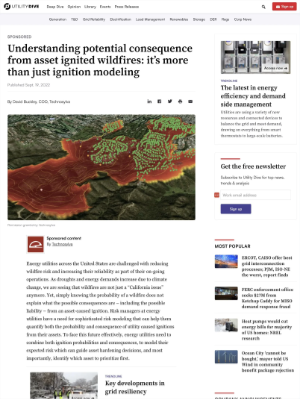
Consequence modeling addresses this by integrating fire spread prediction with forecasted weather to determine where a fire would travel from a specific asset ignition point and what it would impact along the way. The outputs, structures threatened, population exposed, acreage burned, give planners a concrete basis for comparing assets that ignition probability alone cannot provide.
Not all ignitions are created equal. Not all fires are created equal. Consequence modeling is what makes those differences visible and actionable.
Using Consequence Data to Prioritize Hardening
Once consequence is understood at the asset level, it can be combined with ignition probability to calculate expected risk, the foundational metric for defensible hardening prioritization. But consequence modeling also supports a longer-term planning view that goes beyond a single season or event.
By leveraging weather and landscape data over ten or more years, utilities can identify which assets have been consistently associated with the highest potential consequences from ignition across a range of historical conditions. That longitudinal view separates assets that appear risky in one bad season from those that carry genuine long-term exposure. It is the latter that warrant priority hardening investment.
With consequence data grounding the analysis, any hardening decision can be assigned a quantifiable risk reduction. When that reduction is divided by the cost of the mitigation, the result is a risk spend efficiency (RSE) figure. RSE analysis allows utilities to compare hardening options across their asset portfolio and direct limited resources toward the investments that will reduce overall system risk most effectively per dollar spent.
Regulatory Context and Planning Implications
California’s Public Utility Commission regulations have brought consequence modeling and RSE analysis into formal wildfire mitigation planning requirements for utilities in that state. But the planning value of this approach extends well beyond California. Wildfire-related regulation is expanding in scope and complexity across other states, and the underlying logic, that utilities need to demonstrate not just what they did but why they prioritized it, applies regardless of the specific regulatory framework in place.
On the operational side, consequence data also informs Public Safety Power Shutoff (PSPS) decision-making. Knowing which assets pose the highest expected consequence under forecast conditions gives operators a more defensible basis for de-energization decisions than ignition probability alone.
A More Complete Basis for Investment Decisions
Consequence modeling does not replace engineering judgment or operational expertise. It gives planners and risk managers the information needed to make hardening decisions that are grounded in expected impact rather than visible hazard alone. For utilities building or refining their wildfire mitigation programs, integrating consequence modeling into the prioritization process is what moves asset hardening from reactive to systematic.
This article draws on analysis originally published in Utility Dive by David Buckley, former COO of Technosylva.
-
Electric Company Combating Wildfires with Better Technology
Hear from the CEO of PG&E, Patti Poppe, as she explains to Bloomberg News how technology is helping PG&E combat risk the of wildfire through advanced modeling, strengthened situational awareness, and improved decision making for asset hardening.
“Last year we had a 68% reduction in ignitions as a result of our layers of protection, resulting in a 99% reduction in acres burned in one of the very driest years that we had on record. Very tough conditions. So heading into this year, we know we have that technology armed and able to address whatever the conditions are.”

Patti Poppe
CEO, PG&E
-
Electric Company Sees Success in Reducing Their Catastrophic Wildfire Risk

Watch & learn from a great discussion with Pedro Pizarro, CEO of Edison International, about how electric companies are finding success in hardening & adapting their grid to the growing threat of wildfire.