-
Why Ignition Probability Matters for Asset Risk Prioritization
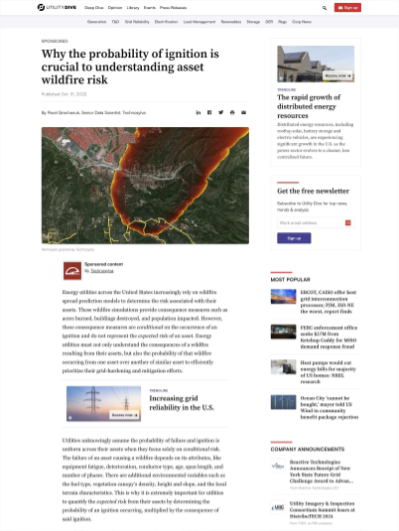
Electric utilities across the United States are increasingly relying on wildfire spread prediction models to assess the risk associated with their assets. These simulations provide valuable consequence measures: acres burned, structures destroyed, population impacted. But there is an important limitation to keep in mind. Consequence measures are conditional on an ignition already having occurred. On their own, they do not represent the full expected risk of an asset.
To prioritize grid-hardening and mitigation efforts effectively, utilities need to understand not just what could happen if a wildfire starts, but how likely it is that one of their assets starts it.
Why Ignition Probability Varies Across Assets
When utilities focus solely on wildfire consequence, they are implicitly assuming that the probability of ignition is the same across all assets. In practice, it is not. The likelihood that a specific asset fails and causes an ignition depends on a range of factors: equipment age and deterioration, conductor type, span length, number of phases, and environmental conditions such as fuel type, vegetation density, slope, and local terrain. Two assets in the same fire-weather zone can carry very different ignition probabilities depending on their condition and surroundings.
Combining Probability and Consequence
A more complete picture of asset risk comes from combining both factors. Grechanuk outlined this framework in a Utility Dive article: expected risk is calculated by multiplying the probability of ignition by the consequence if that ignition occurs.
Consider two hypothetical circuits during a high-wind event:
Circuit A is heavily hardened, with a 2% probability of ignition and a potential consequence of 100 homes destroyed. Its expected risk: 2 homes (0.02 x 100).
Circuit B is moderately hardened, with a 10% probability of ignition and a potential consequence of 40 homes destroyed. Its expected risk: 4 homes (0.10 x 40).
Ranked by consequence alone, Circuit A appears to be the higher priority by a wide margin. Ranked by expected risk, Circuit B carries twice the exposure. A hardening plan that focuses only on consequence would likely direct resources toward Circuit A, even though Circuit B presents the greater overall risk.
This does not mean consequence should be ignored. Public safety is the central concern, and the potential scale of a fire’s impact matters. But probability without consequence, or consequence without probability, each tell only part of the story. The integration of both is what produces a reliable basis for prioritization.
Implications for Hardening Budgets
Understanding expected risk is important not just for day-to-day operations, but for short- and long-term grid-hardening decisions as well. When prioritization is based primarily on consequence, resources can flow toward assets that have already received significant hardening investment and now carry relatively low ignition probability. The law of diminishing returns applies: each additional dollar invested in an already-hardened asset yields progressively less risk reduction.
Asset hardening decisions are often structured through a risk spend efficiency (RSE) analysis, which weighs the expected reduction in risk against the cost of the mitigation. When RSE is calculated using conditional risk rather than expected risk, it tends to favor areas with the most extreme fire behavior potential regardless of how likely ignition actually is. Accounting for ignition probability helps ensure that hardening investments are directed where they will produce the most meaningful reduction in overall system risk.
Hardening budgets are finite. Whether the funding comes from utilities, ratepayers, or government programs, getting the prioritization right has real consequences for communities, for the environment, and for the utilities responsible for managing that risk.
This article is adapted from a piece originally published in Utility Dive.

-
Why Consequence Modeling Belongs at the Center of Asset Hardening Decisions

Simply knowing that an asset could ignite a wildfire is not enough to make a sound hardening decision. Ignition probability tells you where a fire might start. It does not tell you what happens next, or how bad it could get. That distinction matters significantly when hardening budgets are finite and prioritization decisions have real consequences for communities and infrastructure.
As Buckley outlined in a Utility Dive article, ignition is not risk. Risk is the possibility of damage, loss, and harm occurring from an ignition. Two assets with similar ignition probabilities can produce very different outcomes depending on what lies in the potential fire’s path. Understanding that difference is what makes consequence modeling a planning tool, not just an analytical one.
Why Not All Ignitions Are Created Equal
All utility assets carry some probability of failure and ignition. That probability varies based on asset condition, age, design, conductor type, surrounding vegetation, slope, and local weather patterns. But even assets with identical ignition probabilities can pose very different levels of risk depending on where they sit and what a fire starting there would affect.
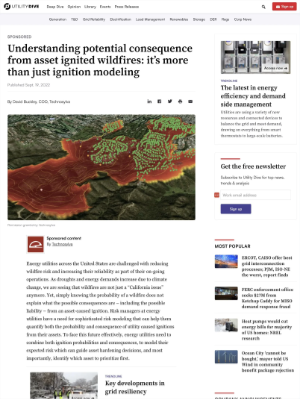
Consequence modeling addresses this by integrating fire spread prediction with forecasted weather to determine where a fire would travel from a specific asset ignition point and what it would impact along the way. The outputs, structures threatened, population exposed, acreage burned, give planners a concrete basis for comparing assets that ignition probability alone cannot provide.
Not all ignitions are created equal. Not all fires are created equal. Consequence modeling is what makes those differences visible and actionable.
Using Consequence Data to Prioritize Hardening
Once consequence is understood at the asset level, it can be combined with ignition probability to calculate expected risk, the foundational metric for defensible hardening prioritization. But consequence modeling also supports a longer-term planning view that goes beyond a single season or event.
By leveraging weather and landscape data over ten or more years, utilities can identify which assets have been consistently associated with the highest potential consequences from ignition across a range of historical conditions. That longitudinal view separates assets that appear risky in one bad season from those that carry genuine long-term exposure. It is the latter that warrant priority hardening investment.
With consequence data grounding the analysis, any hardening decision can be assigned a quantifiable risk reduction. When that reduction is divided by the cost of the mitigation, the result is a risk spend efficiency (RSE) figure. RSE analysis allows utilities to compare hardening options across their asset portfolio and direct limited resources toward the investments that will reduce overall system risk most effectively per dollar spent.
Regulatory Context and Planning Implications
California’s Public Utility Commission regulations have brought consequence modeling and RSE analysis into formal wildfire mitigation planning requirements for utilities in that state. But the planning value of this approach extends well beyond California. Wildfire-related regulation is expanding in scope and complexity across other states, and the underlying logic, that utilities need to demonstrate not just what they did but why they prioritized it, applies regardless of the specific regulatory framework in place.
On the operational side, consequence data also informs Public Safety Power Shutoff (PSPS) decision-making. Knowing which assets pose the highest expected consequence under forecast conditions gives operators a more defensible basis for de-energization decisions than ignition probability alone.
A More Complete Basis for Investment Decisions
Consequence modeling does not replace engineering judgment or operational expertise. It gives planners and risk managers the information needed to make hardening decisions that are grounded in expected impact rather than visible hazard alone. For utilities building or refining their wildfire mitigation programs, integrating consequence modeling into the prioritization process is what moves asset hardening from reactive to systematic.
This article draws on analysis originally published in Utility Dive by David Buckley, former COO of Technosylva.
-
Electric Company Combating Wildfires with Better Technology
Hear from the CEO of PG&E, Patti Poppe, as she explains to Bloomberg News how technology is helping PG&E combat risk the of wildfire through advanced modeling, strengthened situational awareness, and improved decision making for asset hardening.
“Last year we had a 68% reduction in ignitions as a result of our layers of protection, resulting in a 99% reduction in acres burned in one of the very driest years that we had on record. Very tough conditions. So heading into this year, we know we have that technology armed and able to address whatever the conditions are.”

Patti Poppe
CEO, PG&E
-
Electric Company Sees Success in Reducing Their Catastrophic Wildfire Risk

Watch & learn from a great discussion with Pedro Pizarro, CEO of Edison International, about how electric companies are finding success in hardening & adapting their grid to the growing threat of wildfire.