-
Your Guide to Wildfire Risk and Liability Exposure
This webinar discusses understanding current trends in wildfire behavior and their implications on risk and liability exposure, along with methodologies for risk assessment, mitigation strategies, and tools for real-time monitoring and response to wildfire threats.
Duration: 1 hour
This informative webinar, in collaboration with Utility Dive, explores the tactics utilized by leading electric utilities to forecast, mitigate, and respond to wildfire risks and the associated liability.
As wildfires continue to increase in frequency and severity, they present a significant threat to electric utilities infrastructure and communities. Electric utilities face a risk stemming from their infrastructure to trigger wildfires and the liabilities that come with that.
Electric utilities can adopt proactive measures, such as preemptive power shutdowns to minimize the risk of wildfires and safeguard the areas in their service territory as well as using solutions that can help assess assets for mitigation purposes.
During the session, you will learn from Technosylva:
- Insights into the latest trends and patterns in wildfire behavior, and their implications for risk and liability exposure
- Methodologies for assessing wildfire risk and strategies for implementing effective mitigation measures
- Tools and techniques for real-time monitoring and response to wildfire threats
Speakers
David Buckley
Board Advisor
TechnosylvaScott Purdy
Meteorological Analyst
Technosylva -
The PSPS Paradigm Shift

“The lights may go out by design, but the mission has never been clearer: keeping communities safe through decisive operational decision-making.”
Picture this scenario: At 2:47 AM on a wind-whipped October morning, an electric utility meteorologist stares at forecast models with growing unease. What had been predicted as manageable 35 mph winds twelve hours earlier now shows catastrophic potential: sustained winds of 45 mph with gusts reaching 70. In twelve hours, the electric utility might need to make a decision that would have been unthinkable just five years ago: intentionally cutting power for up to 50,000 customers in order to prevent a high-probability catastrophic wildfire.
For electric utilities in wildfire-risk areas nationwide, this scenario represents the new reality of operations. Public Safety Power Shutoffs (PSPS), once a radical concept, have rapidly evolved into the new standard of care. Today, regulators don’t just expect electric utilities to have PSPS programs: they consider it negligent not to have them, even if they’re rarely used.
This requires electric utilities to embrace a fundamental change in mindset, from “we will never turn off the power” to “we will do everything in our power to create a safe community, and minimize the impact of PSPS if it needs to be used.” This comes with a change in operational approach, which requires data, precision and communication to approach PSPS surgically: only when necessary and only where necessary.
The Sprint Against Time
Unlike traditional electric utility operations that can unfold over days or weeks, PSPS decisions happen in a compressed timeframe that leaves no room for hesitation. Electric utilities have maybe 48 to 72 hours from the moment they can forecast high-risk conditions to the moment they need to notify customers. In that window, they’re analyzing thousands of assets, running risk calculations on hundreds of circuits, and making decisions that affect tens of thousands of lives.
This isn’t leisurely analysis: it’s a sprint requiring immediate action and coordinated responses. The process has evolved dramatically since those early days of broad shutoffs, with electric utilities developing increasingly precise approaches to minimize customer impacts while maintaining safety.
But this precision comes at a cost: the need for split-second decision-making under enormous pressure.
The Meteorologist’s Critical Role
In this new paradigm, electric utility meteorologists have become the first line of defense in wildfire prevention. No longer simply weather forecasters, they’re now critical decision-makers whose forecasts trigger million-dollar operational responses. Meteorologists who once focused on telling operations teams what weather to expect now must identify which areas face the highest ignition risk.
The integration between meteorology and operations has become seamless by necessity. Weather data flows directly into asset risk models, which feed into circuit-level decision matrices, which trigger customer notification systems—all within hours of a forecast update.
Building Your Decision-Making Framework
For electric utilities developing or refining their PSPS capabilities, the operational challenge centers on key questions that must be answered before the next high-risk weather event:
Decision Prioritization: What sequence of decisions needs to be established in advance? How do you move from weather forecast to asset evaluation to customer notification in compressed timeframes? Which decisions can be made in parallel, and which must follow a specific order?
Rapid Asset Evaluation: When analyzing thousands of assets under time pressure, how do you prioritize which circuits or equipment to evaluate first? What criteria determine high-priority versus lower-priority areas for immediate risk assessment?
Internal Capability Requirements: What roles and expertise need to be available 24/7 during high-risk periods? How do you structure teams to enable rapid decision-making across meteorology, operations, and customer communications?
Communication Coordination: How do you ensure seamless information flow from weather forecasting through operational decisions to customer notifications? What internal processes prevent communication delays when every hour matters?
These questions don’t have universal answers: each electric utility’s responses will depend on their specific territory, asset configuration, and risk profile. But addressing them in advance creates the foundation for effective PSPS decision-making when time is critical.
The Path Forward
The evolution is measurable: PG&E has brought down its number of impacted customers by over 10x per year through wildfire forecasting, asset-level risk analysis, and circuit control improvements since 2018. What once seemed like an impossible balance (safety and reliability) has become the new standard of excellence.
For electric utility leaders still navigating this transition, PSPS isn’t just another tool in the wildfire mitigation toolkit. It’s a fundamental reimagining of what it means to serve communities responsibly in an era of climate risk. The electric utilities that thrive will be those that embrace this paradigm shift completely, investing in the meteorological capabilities, operational precision, and community relationships that make PSPS not just possible, but optimized and exemplary.
The lights may go out by design, but the mission has never been clearer: keeping communities safe through decisive operational decision-making.

-
Rethinking Wildfire Risk for Electric Utilities
Duration: 45 minutes
As wildfire threats grow in more regions, electric utilities need to rethink how they assess and manage risk. In this webinar, Technosylva’s Steve Vanderburg explains why it’s critical to shift from static assessments to dynamic, real-time tools.
Learn how utilities are using advanced modeling, AI, and weather data to:
- Move from one-time assessments to continuous risk analysis
- Make real-time operational decisions during fire events
- Prioritize mitigation efforts with circuit-level precision
- Strengthen wildfire response plans and infrastructure protection
-
3 Keys to Averting Tomorrow’s Black Swan Natural Catastrophe

“Forecasts show the weather. Climatology shows the why behind the risk.”
Why Electric Utilities Must Move Beyond Forecasts to Climatological Foresight
Electric utilities today face a growing and unpredictable threat: the Black Swan event — a rare but devastating natural catastrophe that can cripple infrastructure and disrupt entire communities. As wildfires and extreme weather events become more frequent and intense, relying solely on traditional weather forecasts is no longer enough.
In a recent Utility Dive piece, Steve Vanderburg, Technosylva’s Vice President for Weather & Risk Solutions, explored how electric utilities can better anticipate and mitigate these high-impact events. Drawing from his experience across government and electric utility roles, he emphasizes the critical need for electric utilities to incorporate climatology, the study of long-term weather patterns, into their risk management strategies.
Here are 3 key takeaways for electric utilities aiming to future-proof their grid
- Forecasts show the weather. Climatology shows the why behind the risk
Traditional weather forecasting tells you what’s coming. But without the context of historical weather extremes, it’s hard to know whether an event is routine or unprecedented. Understanding that a wind event, for example, is in the 99.5th percentile of past data can change the entire response strategy. - Climatology reveals anomalies — and that’s where Black Swans hide.
Wildfires in regions with little prior history, like Oregon’s 2020 Labor Day fires, show how fast the risk landscape can shift. Localized climatological modeling can identify those rare but high-impact scenarios before they happen. - Local fire weather behavior is key to smarter decisions.
A 40 mph gust isn’t the same everywhere. Trees in wind-sheltered zones respond differently than those accustomed to strong gusts. Understanding these localized dynamics helps set better thresholds for action and improve operational resilience.
By understanding the historical climatological context of their service areas, electric utilities can better identify anomalies in current weather patterns and shift from reactive responses to proactive risk mitigation. That means greater accuracy, earlier warnings and a stronger, resilient grid.
Read his full article in Utility Dive to learn how electric utilities are leveraging climatology, ignition modeling, wildfire spread predictions, and impact analysis to forecast risk days in advance. See how leading electric utilities are applying these tools like weather forecasts, ignition models, on-demand wildfire spread predictions, in practice to forecast & monitor wildfire risks before disaster strikes.
- Forecasts show the weather. Climatology shows the why behind the risk
-
Red Flag Warnings Are Helpful but Not the Whole Story

They warn of fire spread, but electric utilities need to know where fires will start.
Red Flag Warnings are a familiar part of wildfire season for anyone working in electric utility operations. When the National Weather Service issues one, it signals that weather conditions are favorable for fire spread: low humidity, dry fuels, and often strong winds. For the general public, that warning is important and actionable. For electric utility risk managers, it is a starting point, not a finish line.
The gap between what a Red Flag Warning tells you and what you actually need to know to protect your infrastructure is where the real risk lives.
Spread vs. Start: Why the Difference Matters
Red Flag Warnings are primarily designed to communicate conditions that allow existing fires to spread rapidly. That is valuable information, but it addresses a different problem than the one utilities are most responsible for managing.
An electric utility’s core concern is ignition. Specifically, whether one of its assets could start a fire. And the conditions that create ignition risk at the circuit level do not always align with the conditions that drive a Red Flag Warning. An asset failure during moderate wind on a day with critically dry fuels and low humidity can spark a fire just as devastating as one that starts under headline-grabbing conditions. Basing operational decisions solely on whether a Red Flag Warning has been issued can lead to both overreaction on broad, low-specificity warning days and underreaction on days where localized ignition risk is genuinely elevated but the warning threshold has not been met.
For utilities of any size, that mismatch carries real consequences. A cooperative serving a rural territory with limited crew resources cannot afford to deploy broadly on every warning day, nor can it afford to miss the days that actually matter.
The Hidden Complexity of Dry Lightning
One of the clearest examples of where Red Flag Warnings fall short for utility operations is dry lightning. Dry lightning, lightning that strikes without significant accompanying rainfall, sits within the Red Flag Warning framework but represents a fundamentally different risk profile than wind and humidity driven warnings.
When dry lightning is the primary hazard, the concern is not one ignition spreading rapidly. It is the potential for numerous simultaneous ignitions across a wide area, any one of which could overwhelm response resources regardless of wind speed. That scenario requires a completely different operational response, including different crew positioning, different communication protocols, and different decisions about de-energization. Treating a dry lightning warning the same way as a wind-driven Red Flag Warning leaves utilities underprepared for one of the more dangerous ignition scenarios they can face.
What Granular Risk Intelligence Provides
The operational gap created by broad public warnings can be closed with more precise, localized risk data. Rather than asking “is there a Red Flag Warning today,” utility risk managers benefit most from asking where, specifically within their service territory, is ignition risk elevated, which assets are most exposed, and what conditions are driving that exposure.
Circuit-level risk intelligence, grounded in real-time weather data, fuel conditions, terrain analysis, and ignition modeling, gives utilities the specificity they need to make proportionate decisions. That means a smaller utility can deploy its limited crews to the areas that actually need attention rather than spreading thin across a broad warning zone. It means a PSPS decision can be surgical rather than sweeping. And it means the reasoning behind every operational call is documented and defensible.
How to Move Beyond the Warning
Red Flag Warnings should remain part of every utility’s situational awareness. They are not the problem. The problem is treating them as sufficient on their own.
Utility risk managers can close the gap by training operations teams to ask deeper questions when warnings are issued: what type of warning is this, what specific conditions are driving it, and how does that map to actual exposure across our service territory? Supplementing public warnings with granular, utility-specific risk data turns a general alert into an actionable operational brief.
The utilities that manage wildfire risk most effectively are not the ones that react to warnings. They are the ones that already know what is happening in their territory before the warning is issued, and have a plan in place before conditions peak.
-
Are you Forecasting and Managing Actual Wildfire Risk?

To protect infrastructure and communities in an increasingly wildfire-prone environment, utilities need a new approach.
Knowing that conditions are hot, dry, and windy is useful. But for an electric utility trying to protect its infrastructure and the communities it serves, it is not enough. Weather conditions describe the environment. They do not tell you which of your assets is most likely to cause an ignition, where a resulting fire would travel, or how many people and structures could be in its path.
That distinction, between knowing conditions and understanding consequence, is at the center of how leading utilities are rethinking wildfire risk management.
The Limits of Weather-Centric Risk Assessment
Red Flag Warnings and standard weather forecasts are essential inputs for situational awareness. No utility should ignore them. But they were designed to serve a broad public safety function, not to drive circuit-level operational decisions.
The core limitation is one of translation. A forecast tells you that wind speeds will reach 40 mph and relative humidity will drop to 10 percent. What it does not tell you is which specific assets in your service territory are most exposed under those conditions, how a fire starting at any one of those assets would behave given local fuels and terrain, or what the potential impact to structures, roads, and populations would be if that fire spread.
For utilities of any size, making operational decisions without that layer of analysis means working with incomplete information. For smaller utilities with limited staff and budgets, it also means that every response, whether deploying crews, initiating a PSPS, or accelerating vegetation management, carries more risk of being either too broad or too narrow.
What Consequence-Driven Risk Assessment Looks Like
The utilities closing this gap are doing so by integrating weather forecast data with fire behavior modeling that is specific to their service territory. Rather than waiting for a warning and then reacting, they are running simulations days in advance that account for forecasted weather, local fuel moisture and fuel type, topography, and asset locations.
The output is not a general risk level. It is a granular, asset-by-asset view of where ignition potential is elevated, where a fire starting from a specific asset would likely spread, and what the potential consequences of that spread would be in terms of structures, population, and infrastructure at risk.
That level of specificity changes how decisions get made. A utility that knows three specific circuits in its territory will carry elevated ignition risk on Thursday can pre-position crews, prioritize inspections on those circuits, notify affected customers, and make a more informed and defensible PSPS decision if conditions warrant it. A utility relying on a regional weather warning alone is making those same decisions with far less to stand on.
Turning Data into Actionable Intelligence
One of the practical challenges utilities face, particularly smaller ones, is aggregating multiple data streams into something their operations teams can actually use in a compressed decision window. Fuel moisture data, weather forecasts, fire spread simulations, asset risk ratings, and impact estimates all need to come together into a clear, current picture of where risk is concentrated and what the appropriate response is.
Leading utilities are consolidating this information into unified risk views, sometimes described as fire size potential maps or daily risk forecasts, that give operations teams a single point of reference for decision-making. The goal is not more data. It is faster, clearer answers to the questions that matter most: where is risk elevated today, which assets are most exposed, and what should we do about it.
This approach also supports longer-term planning. When a utility can see patterns in where risk concentrates across multiple forecast cycles and historical seasons, that data becomes the foundation for smarter vegetation management prioritization, more targeted asset hardening investments, and more credible wildfire mitigation plans submitted to regulators.
The Bottom Line
Every utility operating in wildfire-prone conditions, regardless of size or geography, needs to be able to answer a basic question: if one of our assets caused an ignition today, where would that fire go and what would it affect?
If the answer relies primarily on regional weather warnings, there is a gap worth closing. The technology and data to close it are accessible to utilities of all sizes. The utilities using it are not just better prepared for the next high-risk day. They are building a foundation for every operational and planning decision that follows.
-
Sustained Wind Forecasts from the High-Resolution Rapid Refresh Model: Skill Assessment and Bias Mitigation
-
Can you Forecast the Unprecedented?

The threat of catastrophic wildfires is pervasive and exists almost everywhere. The question is whether your risk framework is built to see it coming.
Over the past five years, catastrophic wildfire events have occurred with a frequency and geographic reach that has challenged how electric utilities think about tail risk. The 2020 Labor Day Megafires along the West Coast. The 2021 Pacific Northwest heat dome, which at its peak exceeded temperatures ever recorded in Death Valley. Wildfires in Hawaii. Fires in regions that had no meaningful wildfire history a decade ago.
For risk managers at electric utilities of every size, the pattern raises an uncomfortable question: if events of this magnitude keep occurring, is the framework being used to assess tail risk still calibrated to the environment utilities are actually operating in?
Technosylva Senior Data Scientist Pavel Grechanuk explored this in a recent Utility Dive piece, arguing that the tools exist to forecast these events, and that utilities willing to invest in the right modeling framework can move from being caught off guard to being genuinely prepared.
The Problem with How Tail Risk Gets Calculated
Electric utility risk managers are familiar with recurrence interval language. A 1-in-100 year event. A 1-in-100,000 year event. These designations are meant to convey probability, but they depend entirely on the quality and completeness of the historical record they are drawn from.
When wildfire events occur in regions with little prior fire history, or under weather conditions that exceed anything in the local record, those recurrence intervals become unreliable. The 2021 heat dome is a clear example. According to research published in Nature, that single event accounted for 21 to 34 percent of total area burned in the United States that year. No historical baseline built from the prior decades would have assigned meaningful probability to that outcome.
For a Risk or Finance executive, this creates a specific problem: if the models underpinning your risk assessment do not account for conditions outside the historical norm, your organization may be carrying exposure that is not visible in your current framework.
What a More Complete Framework Looks Like
Pavel’s piece outlines an approach that combines two layers of analysis that are often treated separately.
The first is climatological analysis, running historical weather data backward 20 to 30 years across a specific service territory to establish a complete baseline of fire weather variability, from typical low-risk days to the most extreme conditions on record. That baseline is what allows a risk manager to understand whether a forecasted event is routine or whether it sits at the edge of historical experience. The second is operational risk modeling, integrating that climatological baseline with current forecasts, asset data, outage records, and fire spread simulation. The output is not just a risk level. It is a view of where the greatest potential consequences would materialize if a fire were to start, which assets carry the highest probability of ignition under those conditions, and what the downstream impacts on structures, infrastructure, and communities could be.
Together these two layers answer the question that recurrence interval calculations alone cannot: not just how likely is an extreme event, but what would it mean for this utility if one occurred here.
Why This Matters for Enterprise Risk Posture
The regulatory and financial community is moving in a clear direction. Credit agencies, insurers, and state regulators are no longer satisfied with risk assessments that describe exposure in general terms. They are asking utilities to demonstrate that they understand their specific risk, that their mitigation strategies are grounded in data, and that their decision-making during high-risk periods is defensible.
A utility that can show its risk framework accounts for tail risk, not just average conditions, is in a fundamentally different position when those conversations happen. It is not just better operationally prepared. It has a more credible story to tell regulators, a stronger basis for insurance negotiations, and a clearer answer for the board when asked what the organization’s exposure looks like in a worst-case scenario.
What does vary is the internal analytical capacity to build and maintain this kind of modeling framework. The regulatory and financial expectations described here apply across utility sizes, and the path to meeting them looks different depending on the organization.
The events of the past five years have made one thing clear: unprecedented is no longer a satisfying explanation for a catastrophic outcome. The tools to anticipate these events exist. Read Pavel’s full piece in Utility Dive for a deeper look at how climatological analysis and operational risk modeling work together to give utilities a framework for forecasting even the most extreme scenarios.
-
Predicting wildfire risk: Enhancing fire danger assessment with high-resolution numerical weather modeling.
-
3 Ways Executives Can Stay Ahead of Wildfire Risk
Just knowing your service area’s wildfire risk is not enough anymore.
Wildfire risk has moved to the top of the agenda for electric utility executives across the country. The liability exposure is real, the regulatory expectations are rising, and the financial consequences of an asset-caused ignition have been made visible in ways that are difficult to ignore. For many executives, the challenge is not recognizing the risk. It is knowing where to focus and how to demonstrate that the organization is managing it with the rigor that insurers, credit agencies, regulators, and boards are now expecting.
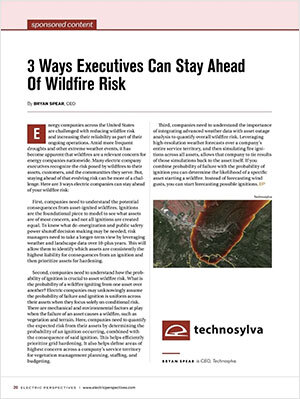
Technosylva CEO Bryan Spear addressed this directly in a piece for Electric Perspectives Magazine, laying out three ways electric company executives can move from a reactive posture to one that is genuinely ahead of their wildfire exposure. The argument is straightforward: wildfire risk is not like other natural hazard risks, and managing it well requires a different kind of analytical foundation.
Why Wildfire Risk Is Different
For most natural hazards, utility risk management focuses on outage restoration and revenue impact. The models are relatively well understood. Wildfire is different because the question is not just whether an outage will occur, but whether an asset failure will cause an ignition, and if it does, what the consequences of that ignition will be for communities, infrastructure, and the utility itself.
That combination of ignition probability and consequence is what makes wildfire risk genuinely complex to quantify, and what makes a generalized or static risk assessment insufficient for the conversations executives are now being asked to have with external stakeholders.
Three Ways to Get Ahead of It
The first is understanding the potential consequences of asset-ignited wildfires. As Bryan writes, ignitions are the foundational piece to model, and not all ignitions are created equal. To understand what de-energization and Public Safety Power Shutoff (PSPS) decision-making may be needed, risk managers need to take a longer-term view by leveraging weather and landscape data over ten or more years. That analysis identifies which assets are consistently the highest liability for consequences from an ignition, and allows executives to prioritize those assets for hardening based on actual potential impact rather than general proximity to risk.
The second is understanding how ignition probability varies across the asset base. Electric companies may unknowingly assume that the probability of failure and ignition is uniform across their assets when they focus solely on conditional risk. In reality, as Bryan notes, there are mechanical and environmental factors at play when the failure of an asset causes a wildfire, including vegetation and terrain. Quantifying the expected risk from assets by combining the probability of an ignition occurring with the consequence of that ignition helps efficiently prioritize grid hardening. It also defines areas of highest concern across a service territory for vegetation management planning, staffing, and budgeting.
The third is integrating advanced weather data with asset outage analysis to build a comprehensive view of overall wildfire risk. By leveraging high-resolution weather forecasts across the entire service territory and simulating fire ignitions across all assets, an organization can tie the results of those simulations back to the asset itself. As Bryan puts it: if you combine probability of failure with the probability of ignition, you can determine the likelihood of a specific asset starting a wildfire. Instead of forecasting wind gusts, you can start forecasting possible ignitions.
What This Means for Executives at Any Size Utility
The three capabilities Bryan describes are relevant for utility executives regardless of the size of their organization. A catastrophic asset-caused ignition carries existential consequences for a small cooperative or municipal utility just as it does for a large investor-owned utility. The financial exposure, the regulatory scrutiny, and the community impact do not scale down with the size of the organization.
What does vary is the internal analytical capacity to build and maintain this kind of modeling framework. The regulatory and financial expectations Bryan describes apply across utility sizes, and the path to meeting them looks different depending on the organization.
The executives best positioned to manage wildfire risk going forward are not necessarily the ones with the largest budgets. They are the ones who understand their specific exposure at the asset level, can quantify the consequences of their highest-risk ignition scenarios, and can communicate that understanding clearly to the stakeholders who are asking.
Read Bryan’s full piece in Electric Perspectives Magazine for the complete argument.
-
Climate teleconnections modulate global burned area
-
Rapid attribution analysis of the extraordinary heat wave on the Pacific coast of the US and Canada in June 2021.