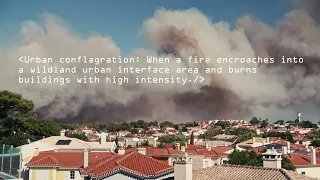
Scientific Research Sustained Wind Forecasts from the High-Resolution Rapid Refresh Model: Skill Assessment and Bias Mitigation 2025. Robert G. Fovell, Scott B. Capps Read Full Article ← Previous Building a Wildfire-Resilient Grid: A Long-Term Planning Approach Next → Improving fire danger forecasting with numerical weather prediction and machine learning (T). Scientific Research Technosylva’s Urban Conflagration Model Helps Utilities and Fire Agencies Prepare for Fires in Populated Areas Technosylva’s Urban Conflagration Model addresses that gap by simulating how fires spread through the wildland-urban interface, where structure density, vegetation encroachment, and fuel types create fire behavior that looks fundamentally different from wildland fires. Scientific Research Assessing the suppression difficulty of wildland fires for initial attack response 2025 • Adrián Cardil, Adrián Jiménez-Ruano, Santiago Monedero, Phillip SeLegue, Macarena Ortega, Raúl Quilez, Jeff Fuentes, Geoff Marshall, Robert Clark, Tim Chavez, Sergio de-Miguel, Tomás Quiñones, Fernando Bezares, Scott Purdy, Kristen Allison, Tim Metzger, Chris Waters, Midhun Mohan, Joaquín Ramirez Scientific Research FIRE-RES Geo-Catch: a mobile application to support reliable fuel mapping at a pan-European scale 2023 • Erico Kutchartt, José R. González-Olabarria, Antoni Trasobares, Sergio de-Miguel, Adrián Cardil, Brigite Botequim, Vassil Vassilev, Palaiologos Palaiologou, Martino Rogai, Francesco Pirotti