-
Beyond Static Assessments: Why Dynamic Wildfire Risk Analysis is Critical to Utility Wildfire Mitigation

“Fire is dynamic. Utilities must evolve beyond static assessments to stay ahead of the threat.”
Electric utilities across the nation are under immense pressure to demonstrate a comprehensive understanding of their wildfire exposure to stakeholders—communities, creditors, regulators, insurers, and boards. However, a fundamental problem lies in the reliance on traditional, static risk assessments. These assessments, while earnestly detailed, create an illusion of preparedness that leaves electric utilities vulnerable to a fundamental truth: fire is dynamic.
The Disconnect Between Static Data and Analyzing Dynamic Risk
Traditional risk assessments provide a fixed snapshot, relying on historical data, terrain analysis, fuel assessments, and extreme scenario modeling, such as the ‘1-in-100-year event.’ While these elements are valuable for establishing a baseline understanding, they are literally obsolete for decision making purposes before they are completed.
Wildfire risk changes from season to season, month to month, day to day and even hour to hour with the weather and its ongoing impact on the terrain and local vegetation.
For electric utilities facing any ignition risk, relying on static assessments is akin to hiking in the woods with an outdated map. The illusion of control offered by a fixed assessment can lead to catastrophic consequences when faced with the daily fluctuations and unpredictable nature of actual wildfire risk.
If you’re reading this blog, the data suggests that you’re right in believing that your risk may be more than you think.
Dynamic Risk Analysis Provides Clarity on Real Risk
Dynamic risk analysis helps to keep the “map” of fire risk up to date at all times, both for planning and operational decisions.
Dynamic risk analysis: builds upon the foundation of a risk assessment by incorporating real-time and forecasted weather data, including granular, commercial-grade weather information. This approach:
- Reduces Wildfire Ignitions: Proactive mitigation based on dynamic risk analysis can significantly reduce the likelihood of electric utility-caused ignitions.
- Creates More Surgical PSPS: By forecasting high-risk periods and locations, electric utilities can better anticipate the need for Public Safety Power Shutoffs (PSPS), reducing the time and areas of customer disruptions and associated safety risks.
- Improves Decision-Making: Real-time and forecasted risk data empowers electric utilities to make more informed decisions about resource allocation, emergency preparedness, and public communication.
- Enhances Stakeholder Communication: Dynamic risk analysis provides concrete data that electric utilities can use to demonstrate their commitment to wildfire safety to regulators, insurers, credit agencies, investors, and community stakeholders.
- Increases the Cost Effectiveness of Vegetation Management and Asset Hardening: With real-time and forecasted risk information, electric utilities can implement more effective mitigation strategies such as targeted vegetation management based on changing conditions, prioritized inspections and equipment maintenance, and ongoing updates of the most critical assets for hardening and capital improvements.
What’s in Dynamic Risk Analysis?
To be effective in providing these benefits, Dynamic Risk Analysis must include:
- Simulation of Wildfire Ignition and Spread: These models not only predict the likelihood of ignition but also simulate how a fire might spread under specific conditions, giving utilities a better understanding of potential impacts.
- A Real-Time View: By integrating current weather conditions and fuel moisture levels, dynamic analysis offers a constantly updated picture of wildfire risk across a utility’s service area.
- Forecasting: Coupled with weather forecasts, dynamic analysis predicts future wildfire risk, allowing utilities to anticipate high-risk periods and take proactive measures.
The Bottom Line
Many electric utilities today make the dangerous assumption that a static, historical snapshot of wildfire risk is sufficient for managing a dynamic, ever-evolving threat. Relying on these outdated assessments leaves electric utilities blind to the real-time fluctuations and forecasted dangers that directly impact ignition and spread potential.
The strongest utilities embrace dynamic risk analysis, integrating real-time and forecasted data, to demonstrate to themselves, their customers, and their financial stakeholders that they are proactively mitigating the escalating threat of wildfire.

-
Are you Forecasting and Managing Actual Wildfire Risk?

To protect infrastructure and communities in an increasingly wildfire-prone environment, utilities need a new approach.
Electric utility risk managers are tasked with an increasingly complex challenge: predicting and mitigating wildfire risk in a dynamic and unpredictable environment. While “Red Flag Warnings” from the National Weather Service have traditionally served as a key indicator of potential fire danger, they fall short of providing the specific, actionable insights needed for effective decision-making.
There is a significant gap between the broad, meteorological focus of Red Flag Warnings and the granular, consequence-driven risk assessments required by electric utilities to protect critical infrastructure and communities. This blind spot leaves utilities exposed to potentially devastating consequences.
The Problem: The Limitations of Weather-Centric Warnings
Primarily, Red Flag Warnings focus on meteorological conditions, such as wind and dryness, but fail to account for the complex interplay of factors that drive actual fire behavior. This leaves electric utilities with a limited understanding of how and where a fire might start and truly impact their service territory.
The core issue is that weather forecasts, while essential, provide conditions, whereas electric utilities require an understanding of consequence. Simply knowing it’s windy and dry doesn’t translate to knowing where assets are most at risk of starting a fire if they come in contact with vegetation or how rapidly that fire may spread.
Furthermore, Red Flag Warnings do not quantify the impact of a potential fire. Adding to the problem is the broad geographic scope of weather-centric warnings. This lack of precision can lead to inefficient resource deployment and missed opportunities for targeted mitigation.
Electric utilities need to understand the potential for property damage, population at risk, and infrastructure loss to make informed decisions about resource allocation and mitigation strategies from one possible start to another.
In addition, models that can predict fire risk days in advance afford leading electric utilities the ability to implement proactive mitigation strategies, a capability that Red Flag Warnings alone do not provide.
How Utilities Can Respond…and Improve:
Leading electric utilities are addressing this problem by integrating weather forecast data with sophisticated, granular fire behavior modeling. They are creating their own granular and days-in-advance view of where fires are likely, where they will spread, and which assets and communities could be involved. This approach:
- Captures Complex Relationships: Instead of just looking at the weather, these models incorporate fuel moisture, fuel type, topography, wind speed, wind direction, and other crucial factors to create a more accurate, more granular view for decision-making. They then simulate how these elements interact to influence fire spread across their service territory and assets.
- Quantifies Risk: By simulating fire spread under forecasted conditions, electric utilities can quantify the potential impacts of a fire. This includes estimating the population at risk, the number of buildings affected, and the acreage potentially burned.
- Identifies High-Risk Areas: Running simulations across a grid allows electric utilities to identify high-risk areas where the combination of fuels, topography, and forecasted weather creates the highest potential for large, damaging fires. Many electric utilities are using this information to do fast-cycle asset hardening or vegetation management days before a potential event. This data also drives longer-term asset-hardening and vegetation management decisions under limited budgets and rate increase abilities.
- Streamlining Data into a Singular View: Electric utilities need to aggregate the results of these simulations into a single, easily digestible product, such as a “fire size potential” map, to have actionable information and quicker decision-making for proactive measures.
What’s Next: The Future of Wildfire Management
Electric utilities require granular data that pinpoints specific areas of elevated risk within their service territory, rather than a general regional warning. Integrating weather forecasting with fire behavior modeling is a critical step towards more effective action by electric utilities. It provides the granular, actionable insights that emergency managers at electric utilities need to protect communities and infrastructure in an increasingly wildfire-prone environment.
-
The Risk Landscape is Changing for Electric Utilities

Wildfire is no longer a regional issue. It’s a national crisis threatening electric utilities’ survival.
The Big Picture
Wildfire, once perceived as a “California problem”, has exploded into a nationwide crisis for electric utilities, driven by escalating liability, growing regulatory demands, and investor anxiety.
The 2023 Lahaina Fire served as a stark wake-up call, forcing electric utilities across the country to confront the existential threat of wildfire and has since been followed by several catastrophic and deadly fires.
Wildfire risk now looms as a top-tier threat capable of bankrupting electric utilities overnight. This shift necessitates a fundamental overhaul of risk management strategies, from improved modeling to proactive mitigation.
What’s Changing, Fast
Liability Risk is Spreading
- The Lahaina Fire tragedy dramatically illustrated that catastrophic wildfire risk extends far beyond traditional high-risk regions. Hawaii Electric’s rapid market cap decline and subsequent large settlement underscore the potential for devastating financial repercussions, regardless of perceived culpability.
- Even in states where liability caps are being considered, they also come with substantial expectations that utilities do everything in their power to manage fire risk.
- The 2024 Smokehouse Creek Fire further solidified the reality that no region and no electric utility is immune from the consequence of asset-caused wildfire ignitions.
Investors, Creditors, and Insurance are Questioning Their Support and Demanding Change
- Electric utilities grapple with uncapped liability, a concern amplified by Warren Buffett’s public questioning of the industry’s investment viability in 2024. Investor confidence is directly tied to an electric utility’s ability to demonstrate robust wildfire risk management.
- Credit rating agencies are especially scrutinizing electric utility wildfire risk management practices and are actively downgrading utilities without such systems actively in place.
- Insurance availability and affordability have become critical challenges, with many electric utilities facing difficulty securing coverage, or resorting to self-insurance.
There are Regulatory and other Stakeholder Pressures
- States outside of California are increasingly implementing stringent regulatory compliance requirements, including mandated wildfire mitigation plans.
- Various stakeholders, including shareholders, local governments, regulators, community members, and insurers are all increasingly demanding that their electric utilities employ proactive wildfire mitigation measures for improved decision-making.
How Electric Utilities Can Respond to the Change and Improve
Electric utility risk managers are no longer facing a theoretical threat. The reality is that wildfire risk, once considered a localized issue, has become a pervasive and financially devastating hazard.
The core problem is the need to accurately understand and quantify a dynamic, complex, and previously underestimated risk.
This isn’t just about modeling fire behavior; it’s about translating that knowledge into actionable mitigation strategies and operational decision-making that address liability, regulatory compliance, investor confidence, and stakeholder trust.
The challenge lies in moving from reactive to proactive, from generalized risk assessments to granular, defensible strategies, and ultimately, ensuring long-term financial stability and operational resilience in the face of an increasingly volatile environment.
What’s Next: Embrace Proactive Risk Management
By leveraging sophisticated tools for real-time monitoring, predictive analytics, and granular consequence modeling, electric utilities can move beyond reactive measures and static assessments.
Electric utilities can advance risk reduction with more data-driven decision-making across all facets of the organization.
For daily operations, this translates to optimized resource allocation, proactive mitigation efforts in high-risk zones, and more informed decisions regarding Public Safety Power Shutoffs.
For long-term asset planning, a clear understanding of wildfire consequence enables electric utilities to strategically prioritize infrastructure hardening and investments.
-
How Downslope Winds Fuel Wildfires

With news media across various western states highlighting strong wind events and their relationship with wildfire risk, it’s helpful to understand why these winds are an issue now, what downslope winds are, and how they impact wildfire behavior.
California’s Santa Ana
At this time of year, you often hear such winds called “Santa Ana winds”, but what does that mean? The name, “Santa Ana”, is a localized name to Southern California for a downslope wind event. As you move more north into Santa Barbara, they are called the “sundowner winds” because they tend to initiate at sunset. In northern California, they are called – ominously – the “Diablo winds”. While downslope windstorms are all similar in nature – each event is unique as they are tied to unique terrain features. All this does make it a bit tricky when you come to a new area to understand exactly what those local patterns are and what they are called. But they are a notorious enough wind to gain their own local names.
Regardless of local nomenclature, downslope winds are the more general feature of those types of named events and they can happen anywhere globally, given the right terrain conditions. The 2021 Marshall Fire in Colorado and the 2023 Lahaina Fire in Hawaii’ were two tragedies fueled by downslope windstorms.
Generally, with downslope wind events, you have very strong winds that can potentially be long-lasting and are usually associated with very dry air masses. Thus, you’ve got strong winds, dry air, and increasingly dry-cured – vegetation that is prime for ignition. These prolonged wind events can, potentially, have higher risk impacts because they have more drying potential on the vegetation, making them easier to ignite. Other critical fire weather patterns with equivalent winds, such as those associated with cold fronts or frontal passages will be more short-lived and are often associated with precipitation as well, reducing ignition potential and keeping them out of the headlines.
How Downslope Winds Work
It all comes down to how airflows and moves over or around a mountain. Depending on what that topographic feature is, you might have air flow splitting and just going around a mountain peak or ridgeline. When the wind starts to flow over the top of a mountain, that’s when you see downslope wind storms. Since the wind can’t go around, it is forced to go over the top, and under the right conditions (or wrong conditions), it collides with a stable air mass above, inhibiting the upward flow and over the terrain. Those stable layers essentially deflect all that upward energy back downward resulting in accelerated winds at the surface on the leeward side of the terrain. This creates a strong downward flow pulling air from aloft.
This is called the venturi effect and is analogous to covering most of the spout of a garden house with your thumb. The flow and pressure of the water increase with a much smaller spout. In a downslope windstorm, the stable layer aloft acts as the thumb, pinching the flow between that stable layer and the crest of the local terrain. This results in air shooting down the leeward side of the mountain.
Impacts to Wildfire Risk and Electric Utility Planning
The impacts of downslope winds on wildfire risk are dramatic because this increased wind can rapidly strengthen the spread and intensity of an otherwise small ignition. Electric utilities need the ability to identify, days in advance, areas of concern and predict wildfire spread and the impacts of potential fires from their assets and across their territory. This enables public and stakeholder communications, staging of field resources, and other logistical preparations for proactive de-energization and it can be done surgically by identifying which assets are most likely to fail and the consequence of any given failure.
Very similar planning tools identify where and when such conditions have previously occurred supporting prioritization of asset hardening that minimizes costs while safeguarding the grid and the public. See how leading electric utilities employ various tools like weather forecasts, ignition models, on-demand wildfire spread predictions, and impact analysis to forecast & monitor wildfire risks days in advance.
-
Can you Forecast the Unprecedented?

The term “unprecedented” is often used in the media to describe seemingly new wildfire impacts. Yet, we have seen numerous “unprecedented” wildfire events in the past five years stemming from asset-caused ignitions. For a risk manager at an electric utility, it’s crucial to recognize that the threat of catastrophic wildfires is pervasive and exists almost everywhere.
Technosylva’s Senior Data Scientist, Pavel Grechanuk, explains that the wildfire mitigation strategies of electric utilities demand more than a simple designation of risk levels. Electric utilities need a comprehensive, nuanced approach that recognizes the complexities of fuels, climate, and people. More importantly, by combining climatological analysis with operational risk modeling, electric utilities can forecast catastrophic events and take action ahead of time to minimize impacts.
5 Key Takeaways:
- Unprecedented Wildfires Are Increasingly Common: Climate change is making severe wildfires more frequent and unpredictable, even in previously low-risk areas.
- Comprehensive Risk Assessment is Essential: Utilities need to go beyond simple risk designations and consider factors like fuels, climate, and people to accurately assess their wildfire risk.
- Climatological Analysis and Operational Risk Modeling Are Crucial: Combining these two approaches helps utilities understand what is normal and what is coming in the near term, enabling better forecasting of unprecedented events.
- Advanced Fire Spread Modeling is Necessary: This technology can predict where a fire will go and its potential impacts, aiding in decision-making.
- Proactive Management is Key: By implementing a comprehensive modeling framework, utilities can better prepare for and respond to severe weather events, even those that were previously considered unprecedented.
Read our full article in Utility Dive and see how leading electric utilities are advancing their outage analytics to help prioritize asset hardening and vegetation management decisions.
-
Modeling Consequence to Properly Reduce Asset-Caused Wildfires

Understanding potential consequence from asset ignited wildfires: it’s more than just ignition modeling.
Simply knowing the probability of a wildfire across an electric company’s service area does not explain what the possible consequences are – including the possible liability – from an asset-caused ignition. Energy companies in the United States are facing a growing challenge of reducing wildfire risk while ensuring reliable operations. To achieve this, their managers need sophisticated risk modeling that can help them quantify both the probability and consequence of asset-caused ignitions to ensure they are providing the best operations and mitigation decision-making.
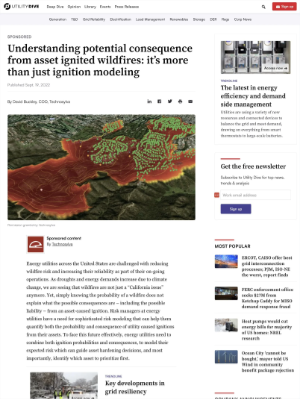
Technosylva’s COO, David Buckley, explained in a Utility Dive article that if you can’t explain the consequences of one asset-caused wildfire over another, you can’t properly plan for your risk, or ensure the safety of the communities you serve. Yet, how does understanding the consequences of an ignition help in mitigating risk? It allows for a historical assessment of the probability of wildfire ignitions at specific asset points and the potential impacts they could have. This information is crucial in making informed decisions on which mitigation measures to implement. Additionally, by integrating advanced fire spread prediction modeling with weather forecasts, utilities can determine where fires are most likely to spread from asset ignition sources and the potential consequences.
Buckley also stresses the importance for risk managers to differentiate between ignition and risk, meaning that not all wildfire ignitions pose the same level of risk. By understanding the different severity of potential fires, electric companies can identify which assets are most at risk and prioritize them for hardening. This requires a longer-term view, utilizing weather and landscape data over several years to accurately assess the consistent liabilities to properly define consequences across their network.
Learn how you can predict, mitigate, and prevent your evolving wildfire risk and additionally, how Technosylva solutions provide leading electric utilities with increased risk management, operations, asset mitigation, emergency planning, regulatory compliance, and improved public safety.
You can read the full article on Utility Dive here.
-
Technosylva Develops the Methods to Make Fire Simulations Explain Observed and Predicted Events in Real-Time
Fire simulations have greatly improved the way fire agencies and others approach wildland fire management. These tools allow the prediction of how a fire will spread and behave, giving firefighters valuable information for strategic decision-making. However, even with the help of these advanced simulations, there are still limitations and uncertainties that can affect accuracy.
To address this, Technosylva led a 2019 peer-reviewed study, published in the academic journal, Ecological Modelling, demonstrating an innovative method implemented in Wildfire Analyst™ to adjust fire simulations in real-time. The method determines the adjustment factors needed for the optimal rate of spread by fuel model to minimize the arrival time error between the simulated fire and a set of control points where the arrival time of the observed (real) fire is known. The results showed a significant reduction in error and a better fit between the simulated fire growth and the actual fire spread.
“This is a unique simulation mode we have in Wildfire Analyst™ that fire agencies and others can utilize in operational environments. You compare your simulated perimeter with the real fire perimeter coming from satellite platforms, available cameras, or field information. The analysis proved that we can better predict the rate of spread when conditions like convective or erratic wildfire behavior go beyond the modeling by teaching the fire spread model with a mathematical approach to incorporate these unexpected variables.
The advancement is that, while before you needed to calculate this manually through several interactions, now you can do this process automatically. Additionally, you can analyze both error and bias of all this process, therefore improving the process, especially if you are doing it in an operational environment,”

Adrián Cardil, Ph. D
Lead Author & Senior Fire Researcher
Insight from the Research
Fire agencies have turned to fire simulation and modeling as crucial tools to help predict how wildfires will spread and behave under various conditions. This insight aids in the development of strategies and tactics for firefighting and prevention efforts. Numerous fire simulation software tools have been developed over the years, including Farsite, Nexus, FlamMap, BehavePlus, ForeFire, and Wildfire Analyst (WFA).
While these simulations are powerful tools, their accuracy is vital for effective decision-making during wildfire incidents. However, several factors can introduce uncertainties and errors into fire simulations, including limitations and assumptions in the models and uncertainties in input data such as weather, fuel types, and topography. These uncertainties can make simulations deviate from actual fire spread, which can be problematic in real-time firefighting situations.
A Novel Method of Approach
A groundbreaking method implemented in Wildfire Analyst allows for the adjustment of fire simulations in real-time. The objective of this method is to determine adjustment factors that optimize the rate of fire spread according to the specific fuel model, minimizing the error in arrival times compared to observed control points.
The analysis reviews two case studies from Catalonia, Spain, where this method was applied. The study area’s climate is characterized by hot and dry summers with low winter precipitation, making it prone to wildfires. The selected fires, Castell d’Aro and San Llorenç Savall, were closely monitored by firefighters during suppression operations, providing valuable data for testing the adjustment method.
Research Findings
The heart of the method lies in computing Rate of Spread (ROS) adjustment factors for various fuel models involved in fire simulations. These factors are specific to each fuel model and are used to adjust the initial ROS. The adjustment process is based on a least squares approach, aiming to minimize the error between simulated fire growth and real-world observations. The method allows for real-time adjustments and requires minimal input data.
The results of the case studies demonstrate the effectiveness of this approach. Without adjustment, the initial simulations significantly underestimated the actual ROS, particularly at the head of the fires. However, after applying the adjustment factors, the simulated fire spread closely matched the observed fire’s behavior, reducing both time and area errors.
The implications of this method are significant. Firefighters and managers can now have access to more accurate and consistent fire simulations, especially during real-time wildfire situations where quick decisions are crucial. This tool can be used to reconstruct past fires, analyze fire behavior, and support operational planning and decision-making.
While the adjustment method presented in this study is a game-changer for enhancing the accuracy of fire simulations, there are several considerations to keep in mind. It primarily adjusts the fuel models included in the adjustment mode, so the presence of additional fuel models in forward-time simulations may require further adjustments. Factors such as local winds, not considered in initial simulations, can also influence ROS differently in different areas.
Next Steps from the Research
The study’s innovative method for real-time adjustment of fire simulations is a valuable addition to the firefighting toolkit. It addresses the critical need for accurate fire spread predictions in the face of increasingly frequent and severe wildfires. By reducing uncertainties and errors in simulations, it empowers firefighting agencies to make more informed decisions and better protect lives, property, and the environment in the battle against wildfires.
Learn more about how this science is put into practice.
-
Technosylva and CSU Researchers Investigate How to Measure the Survival-Likelihood of Individual Buildings Effected by Wildfire
Wildfire events in California and around the world have resulted in significant social and economic losses. In response, there is strong focus on modeling wildfire behavior in the wildland to aid in developing strategies for fuel reduction and fire suppression. Post-fire observations of several historic fires indicate that within affected communities, some ignitable structures tend to survive even when most in close vicinity have been destroyed. This apparent spatial randomness in damage patterns raises an important question: Can the likelihood of survival of individual buildings be predicted for wildfire events?
What is needed is a more holistic approach that integrates the characteristics of the wildland with the features of the built environment to better predict damage and building loss.
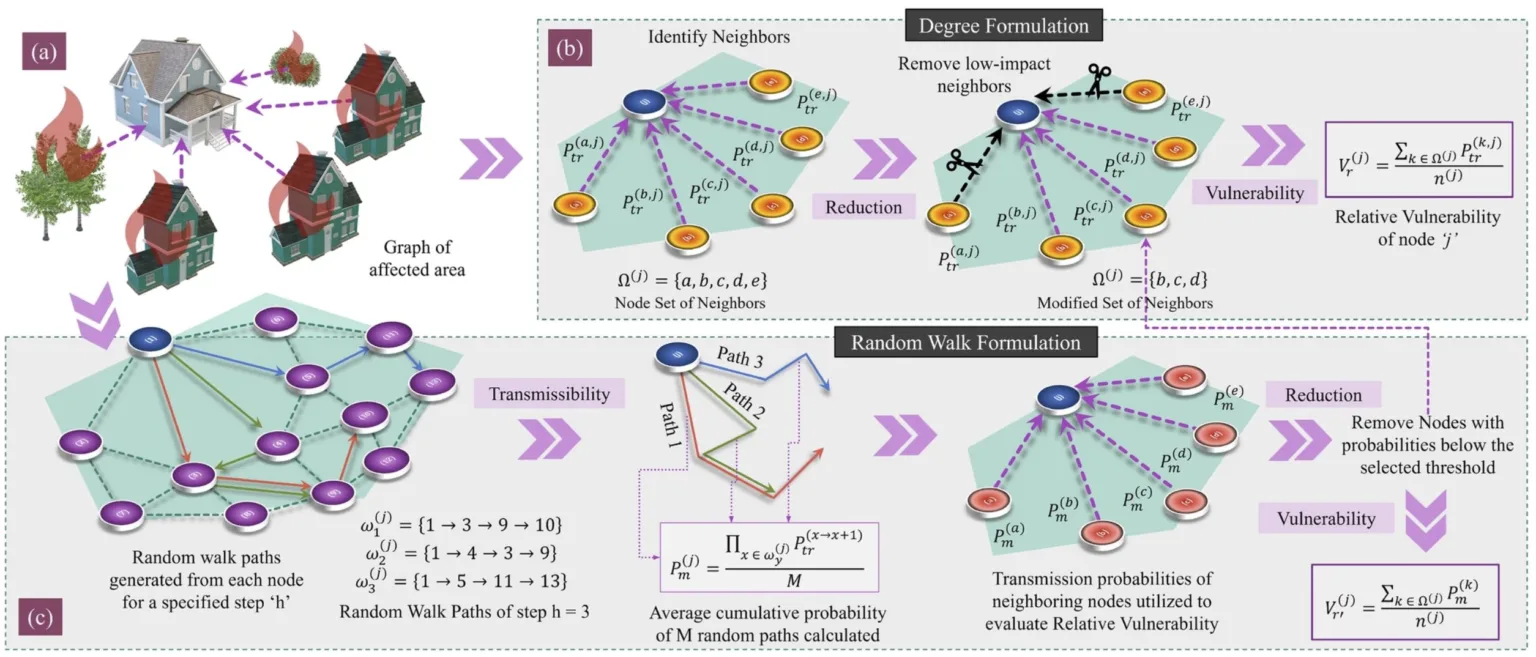
To advance this important modeling goal, Technosylva led a 2022 peer-reviewed study, published in the academic journal, Scientific Reports, that utilized integrated concepts from graph theory to create a relative vulnerability metric that can quantify the survival likelihood of individual buildings within a wildfire-affected region. By emulating the damage observed in historic wildfires the analysis was able to test and refine this framework, resulting in findings showing that both formulations modeling loss at the mid and extreme ranges based on graph centralities were effective in evaluating the vulnerability of buildings relative to each other.
“We wanted to create models that could help to understand, in an operational way, the complexity of the building-to-building risk of fire propagation and try to understand the potential of urban conflagration. This kind of modeling is really complex and we wanted to make the actual models better when we apply fire simulations and ignition impact forecasting to operations. This means moving from empirical models to a little more physics-based models in a way that it could be applied to nation scale or even after global scale. To do that we have to go to the basics of fire and fire behavior and build back out.”

Joaquin Ramirez, Ph.D
Co-Author – President & CTO
Insight from the Research
The study presents an innovative approach to predict the survival of individual buildings during wildfire events by utilizing concepts from graph theory. It addresses a crucial question in the field of fire management: why do some structures within fire-affected communities manage to survive while neighboring buildings succumb to the flames? While traditional wildfire behavior models excel in natural environments, they often fall short in explaining the complex dynamics within built-up areas. This study seeks to bridge that gap by introducing a novel methodology that leverages graph theory to model wildfire propagation within communities.
Cite: Integrated graph measures reveal survival likelihood for buildings in wildfire events
Defining the Modeling in the Research
The research begins by introducing a wildfire graph model, which serves as the foundation of the study. The model represents the intricate interactions between buildings and vegetation in areas affected by wildfires. To enhance the model’s accuracy, the researchers include nodes to account for both wildland vegetation and urban vegetation. These two types of vegetation are recognized as influential factors in determining fire intensity and rate of spread. Additionally, the model incorporates various building features, such as deck type, eaves, roof type, vent type, fence, and window pane, as these factors significantly affect a structure’s vulnerability to wildfires.
Centrality Measures and Building Vulnerability
The core of the study involves evaluating different centrality measures from graph theory to assess the vulnerability of individual buildings within the wildfire-affected community. The traditional centrality measures considered include:
- Closeness Centrality: Measures how close a node is to all other nodes in the network.
- Eigenvector Centrality: Evaluates a node’s influence based on its connections to other influential nodes.
- Clustering Coefficient: Assesses the extent to which a node’s neighbors are connected to each other.
- Gravity Centrality: Determines the importance of nodes based on their spatial distribution within the network.
- Degree Centrality: Measures the number of connections a node has.
- Betweenness Centrality: Identifies nodes that act as bridges between different parts of the network.
The traditional centrality measures are widely accepted in network analysis but were found to have limited accuracy when it comes to predicting building damage in wildfire scenarios.
Novel Formulations for Building Vulnerability
To address the shortcomings of traditional centrality measures, the paper introduces two novel formulations for assessing building vulnerability:
- Modified Degree Formulation: This approach focuses on the influence of nearby nodes. It calculates the relative vulnerability of individual buildings by considering the mean of incoming edge weights from neighboring nodes. Furthermore, it introduces a mechanism to remove low-impact connections, thereby enhancing accuracy.
- Modified Random Walk Formulation: This formulation utilizes random walks to assess the spreading power of nodes within the network. It calculates the relative vulnerability based on the concepts of random walk and information entropy.
Research Findings
The study rigorously tests these novel formulations alongside traditional centrality measures on two historic wildfires, namely the 2018 Camp Fire and the 2020 Glass Fire. The results indicate that the modified degree and random walk formulations outperform traditional centrality measures in predicting building damage. While none of the formulations achieved exceptionally high accuracy, they provided valuable insights into general damage patterns within different regions affected by wildfires.
Next Steps from the Research
The study acknowledges the inherent challenges in modeling wildfire behavior, including aleatory uncertainties (randomness) and limited data availability at the community level. It emphasizes the need for improved models that can account for both aleatoric and epistemic uncertainties, which include factors like local weather effects and the extent of fire spread. While the proposed formulations represent a significant step forward, the authors highlight the complexity of the research problem and the need for further refinement and data collection.
The study offers a promising avenue for better understanding and mitigating the impacts of wildfires on communities. It introduces innovative concepts from graph theory to enhance our ability to predict building survivability in wildfire events, providing valuable tools for fire management and community planning.
Learn more about how this science is put into practice.
-
Measuring Wildfire Exposure to Communities is Possible in Real Time
Wildfires are a major threat to communities and their impacts can be devastating. That’s why it’s so important to have accurate information about the time and likelihood of a wildfire reaching a particular area. This is where wildfire decision trigger modeling comes into play. It helps fire agencies assess fire exposure and create evacuation plans with enough warning time.
But there’s one key aspect that hasn’t received much attention: input data uncertainty. To address this, Technosylva led a 2019 peer-reviewed study, published in the academic journal, Science of The Total Environment, showcasing a new stochastic fire simulation decision trigger modeling method that considers potential variations in input data to assess the probability of wildland fire impact.
”This was the first time that we tried to apply fire impacts for building consequence modeling instead of evaluating the impacts. For a fire, we wanted to explore how we can better model the vulnerability that a community has in its critical asset in much the same way others model flood impacts to coastal communities at risk. It means asking what is the exposure that you may have from considering the historical conditions on weather and the immediate conditions at the location.
The analysis allows you to model risk associated with an asset’s exposure variable. In this analysis, we explained the method of that risk associated to balance exposure, which is very powerful. We know where the assets are and their individual risk, but we don’t know where the fire is. So, the model can assess asset risk, and with applied weather conditions, we can tell what the exposure of this community would be to a fire and the possible outcome if it was hit. This is a big advantage to fire agency operations for evacuation planning and timing of those decisions.”
Joaquin Ramirez, Ph.D
Lead Author – President & CTO
Insight from the Research
Accurately predicting wildfire behavior is challenging due to uncertainties in input data and the inherent limitations of fire models. Wildfire simulations, which use various models and data to predict fire behavior, have been crucial in managing wildfires. These simulations help fire management agencies plan controlled burns, assess fire risks, and develop real-time strategies for suppression.
Several types of fire spread models have been developed, ranging from physical-based models to empirical and mathematical ones. These models consider various factors like vegetation, weather conditions, and fuel moisture to estimate critical fire behavior parameters such as the rate of spread and flame intensity.
Protecting vulnerable areas, such as wildland-urban interfaces (WUIs), is a primary concern for fire agencies. They need accurate predictions of when and where fires might impact these areas to make informed decisions about evacuations or shelter-in-place strategies. However, the accuracy of such predictions depends on the uncertainty associated with input data, including factors like topography, fuel type, and weather conditions.
To address these challenges, the study presents an innovative approach leveraging wildfire decision trigger modeling. This uses well-established semi-empirical fire spread models and incorporates stochastic elements to simulate decision trigger buffers around areas to be protected. These buffers represent the time it would take for a fire to reach the protected area under various input conditions, providing probabilities of impact.

Cite: Joaquin Ramirez Defining The Modeling in the Research
The model incorporates random elements into a simulation, which better reflects the chaotic and unpredictable nature of wildfires. By using random data inputs, you can produce a range of possible outcomes, rather than just one deterministic prediction. By simulating different scenarios, it produces a probability map of the fire’s arrival to areas that need to be protected.
To demonstrate the decision trigger modeling concept, the study used data from the Tubbs fire, one of California’s most destructive wildfires. The analysis ran fire simulations backward in time from selected ignition points to the edge of the WUI around Santa Rosa. The simulations estimated the time it would take for a fire to reach the WUI, and the results were compared with the actual fire progression to validate the accuracy of the decision trigger modeling method.
The decision trigger modeling method uses an ensemble approach, varying input conditions such as wind speed, wind direction, and fuel moisture content to account for input data uncertainties. It generates multiple fire simulations under different conditions to provide probabilistic estimates of fire arrival times.
Research Findings
The study found that the fire simulations using the decision trigger modeling method had a high degree of accuracy when compared to the actual fire spread during the Tubbs fire. The evacuation trigger buffers estimated by decision trigger modeling correctly predicted the time of arrival of the fire at the WUI edge. The ensemble method used for weather conditions showed that the predicted rate of spread (ROS) varied significantly depending on the input conditions. This variability highlighted the importance of considering weather uncertainty in fire behavior modeling.
The decision trigger modeling method offers a valuable framework for estimating the probability of wildfire impact in areas to be protected in real time, accounting for input data uncertainties. It provides decision-makers with information about potential fire spread and the associated probabilities, aiding in evacuation planning and the development of fire suppression strategies.
The study emphasized the need for considering uncertainties beyond weather conditions, including model limitations, fire-atmosphere interactions, and data quality. While the decision trigger modeling method showed promise, it is essential to combine it with expert knowledge and judgment for more accurate decision-making.
Next Steps from the Research
The wildfire decision trigger modeling approach presented in this study offers a novel way to predict wildfire impacts on vulnerable areas. By incorporating input data uncertainties and providing probabilistic estimates,decision trigger modeling enhances decision support for fire management agencies.
However, the study highlights the importance of considering various sources of uncertainty to improve the accuracy of fire behavior predictions in operational environments. Decision trigger modeling has the potential to become a valuable tool for assessing fire risk and protecting communities in the face of increasing wildfire threats.
Learn more about how this science is put into practice.