-
Xcel Energy: Protecting the Texas Panhandle Before the Fire Starts
Hear from Xcel Energy about how Technosylva’s real-time wildfire intelligence helped them respond to a historic storm event in the Texas Panhandle. With 8 days of advance warning and fire behavior modeling running throughout the day, Xcel was able to identify the highest-risk areas, execute a proactive power shutoff, and restore service quickly during extreme fire weather conditions.
“We utilized Technosylva to model those ignitions as fast as possible, so we understood what the potential impact to our system was.”

Samuel Larsen
Manager, Wildfire Risk Modeling and Data Science
-
Technosylva’s Urban Conflagration Model Helps Utilities and Fire Agencies Prepare for Fires in Populated Areas
Wildfire models have traditionally focused on forests and open land, not neighborhoods. Technosylva’s Urban Conflagration Model simulates how fires spread through buildings and streets, giving utilities and fire agencies the forward visibility they need to make smarter, risk-based decisions to protect the communities they serve.
“Traditional wildfire models were designed for wildland fuels and fire behavior. Our approach builds on that foundation by showing how fires actually move through communities.”

Bryan Spear
CEO, Technosylva
-
How CORE Electric Cooperative Puts Member Safety at the Center of Wildfire Mitigation
Hear from CORE Electric Cooperative about how Technosylva’s advanced weather and risk data helps protect more than 375,000 members across agricultural, urban, and high-risk forested regions. With real-time wildfire intelligence, CORE can identify dangerous conditions early, adjust system settings proactively, and reduce fire risk without unnecessary outages. All while honoring their commitment to responsible, member-first service.
“Technosylva gives us the information that lets us predict those high-risk conditions, but also the spatial granularity and temporal granularity to determine exactly where and when we need to do that.”

Jordan Ambrogi
Wildfire Mitigation Manager, CORE Electric Cooperative
-
How Bear Valley Electric Service Protects a High-Risk Territory with Dynamic Wildfire Intelligence
Bear Valley Electric Service serves a 32-square-mile territory located entirely within a California High Fire Threat District, where precise, timely intelligence is essential. Technosylva’s dynamic wildfire analytics replaced static risk models and gave BVES the circuit-level decision making their environment demands. This demonstrates how small, capable teams can rely on proven science to protect communities and strengthen resilience in high-risk environments.
“Technosylva’s platform allows us to be surgical in our operations while providing public safety and minimizing impacts on our customers.”

Paul Marconi
President, Bear Valley Electric Service
-
Beyond Static Assessments: Why Dynamic Wildfire Risk Analysis is Critical to Utility Wildfire Mitigation

“Fire is dynamic. Utilities must evolve beyond static assessments to stay ahead of the threat.”
Electric utilities of every size, from large investor-owned utilities to small cooperatives and municipal providers, are facing the same fundamental challenge: wildfire risk evolves faster than any fixed assessment can capture. The tools that worked in the past may no longer be enough.
Traditional, static risk assessments have long been a cornerstone of wildfire mitigation planning. They are detailed, methodical, and well-intentioned. But they are built on historical data, terrain analysis, fuel assessments, and scenario modeling, a fixed snapshot of conditions that may have existed months or even years ago. By the time a static assessment is completed, it is already out of date. And for a utility making operational decisions today, that gap matters.The Limits of a Static Risk Assessment
Wildfire risk shifts constantly. Weather patterns change season to season, month to month, day to day, and even hour to hour. Fuel moisture levels fluctuate. Vegetation conditions evolve. A service territory that carried moderate risk last fall may look very different after a dry winter and an early heat event.
Relying on a static assessment to guide real-time decisions is like navigating with a map that was printed before the roads changed. For a large utility with thousands of miles of line, that gap creates blind spots. For a smaller utility with limited staff and tighter resources, it can mean making critical calls, on de-energization, crew positioning, customer notification, without a current picture of actual conditions.
The consequences of that gap are not theoretical. Utility-caused ignitions during periods of elevated but undetected risk have resulted in catastrophic outcomes for communities and lasting financial and operational consequences for the utilities involved.
What Dynamic Risk Analysis Does Differently
Dynamic risk analysis builds on the foundation of a static assessment by layering in real-time and forecasted weather data, current fuel conditions, and continuous fire behavior modeling. The result is a living view of risk, one that updates as conditions change and supports decisions across both planning and day-to-day operations.
For utilities at any scale, this approach delivers several concrete operational advantages.
It reduces the likelihood of ignitions by enabling proactive mitigation tied to actual current conditions rather than historical averages. When a utility can see elevated risk developing days in advance, it can act before conditions become critical.
It supports more precise Public Safety Power Shutoff (PSPS) decisions. Rather than applying broad de-energization across wide areas in response to a Red Flag Warning, utilities can identify the specific circuits where risk is genuinely elevated and focus action there. This matters enormously for smaller utilities, where a wide-area shutoff can disproportionately impact customers and strain limited restoration resources.
It improves how resources get deployed. Crew pre-positioning, equipment staging, and inspection prioritization all become more defensible and more effective when grounded in current risk data rather than assumptions.
It strengthens communication with customers, regulators, and community partners. When a utility can explain its decisions with real data, it builds the kind of trust that is difficult to establish any other way.
What Effective Dynamic Analysis Requires
Not all dynamic risk tools are equal. To be operationally useful, a dynamic risk analysis capability needs to include three core components.
First, wildfire ignition and spread simulation. Understanding not just where an ignition might occur, but where a resulting fire could travel and what it could impact, is essential for calibrating operational response.
Second, a real-time view of current conditions. Integrating live weather data and fuel moisture levels gives operators an accurate, up-to-date picture of risk across their service territory at any given moment.
Third, forward-looking forecasting. Knowing that risk is likely to spike in 48 or 72 hours allows utilities to prepare, not just react. For smaller utilities that may not have round-the-clock meteorological support, access to reliable forecasted risk data can be particularly valuable in closing that gap.
The Bottom Line
Static assessments serve a purpose. They establish a baseline, support regulatory filings, and document a utility’s understanding of its risk landscape. But they were never designed to drive real-time operational decisions.
Every utility that faces ignition risk, regardless of size, geography, or regulatory environment, needs a current view of that risk. Dynamic analysis is how that view gets built and maintained. The utilities making the strongest operational decisions today are the ones that stopped relying on a map that stopped being accurate the moment it was printed.

-
Why Ignition Probability Matters for Asset Risk Prioritization
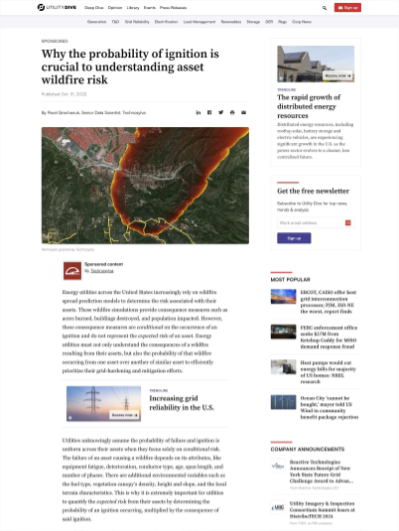
Electric utilities across the United States are increasingly relying on wildfire spread prediction models to assess the risk associated with their assets. These simulations provide valuable consequence measures: acres burned, structures destroyed, population impacted. But there is an important limitation to keep in mind. Consequence measures are conditional on an ignition already having occurred. On their own, they do not represent the full expected risk of an asset.
To prioritize grid-hardening and mitigation efforts effectively, utilities need to understand not just what could happen if a wildfire starts, but how likely it is that one of their assets starts it.
Why Ignition Probability Varies Across Assets
When utilities focus solely on wildfire consequence, they are implicitly assuming that the probability of ignition is the same across all assets. In practice, it is not. The likelihood that a specific asset fails and causes an ignition depends on a range of factors: equipment age and deterioration, conductor type, span length, number of phases, and environmental conditions such as fuel type, vegetation density, slope, and local terrain. Two assets in the same fire-weather zone can carry very different ignition probabilities depending on their condition and surroundings.
Combining Probability and Consequence
A more complete picture of asset risk comes from combining both factors. Grechanuk outlined this framework in a Utility Dive article: expected risk is calculated by multiplying the probability of ignition by the consequence if that ignition occurs.
Consider two hypothetical circuits during a high-wind event:
Circuit A is heavily hardened, with a 2% probability of ignition and a potential consequence of 100 homes destroyed. Its expected risk: 2 homes (0.02 x 100).
Circuit B is moderately hardened, with a 10% probability of ignition and a potential consequence of 40 homes destroyed. Its expected risk: 4 homes (0.10 x 40).
Ranked by consequence alone, Circuit A appears to be the higher priority by a wide margin. Ranked by expected risk, Circuit B carries twice the exposure. A hardening plan that focuses only on consequence would likely direct resources toward Circuit A, even though Circuit B presents the greater overall risk.
This does not mean consequence should be ignored. Public safety is the central concern, and the potential scale of a fire’s impact matters. But probability without consequence, or consequence without probability, each tell only part of the story. The integration of both is what produces a reliable basis for prioritization.
Implications for Hardening Budgets
Understanding expected risk is important not just for day-to-day operations, but for short- and long-term grid-hardening decisions as well. When prioritization is based primarily on consequence, resources can flow toward assets that have already received significant hardening investment and now carry relatively low ignition probability. The law of diminishing returns applies: each additional dollar invested in an already-hardened asset yields progressively less risk reduction.
Asset hardening decisions are often structured through a risk spend efficiency (RSE) analysis, which weighs the expected reduction in risk against the cost of the mitigation. When RSE is calculated using conditional risk rather than expected risk, it tends to favor areas with the most extreme fire behavior potential regardless of how likely ignition actually is. Accounting for ignition probability helps ensure that hardening investments are directed where they will produce the most meaningful reduction in overall system risk.
Hardening budgets are finite. Whether the funding comes from utilities, ratepayers, or government programs, getting the prioritization right has real consequences for communities, for the environment, and for the utilities responsible for managing that risk.
This article is adapted from a piece originally published in Utility Dive.
-
Powering Down for Safety: The New Reality of Electric Utility Operations

“The decision to implement a PSPS is never taken lightly. But in an era of escalating wildfire risk, it may be one of the most important decisions a utility makes.”
For decades, the core mission of an electric utility has been straightforward: keep the lights on. Reliability was the scorecard. Outages were the enemy. That mission has not changed, but the conditions surrounding it have.
Public Safety Power Shutoffs (PSPS), the practice of proactively de-energizing lines that pose an ignition risk during dangerous weather conditions, have become an essential part of wildfire mitigation for utilities across the country. For many utilities, especially those that have not historically dealt with significant wildfire exposure, building a PSPS program represents a genuine operational and cultural shift. It asks utility teams to do something that runs counter to everything they have been trained to prioritize: intentionally turn off the power.
Understanding why that shift is necessary, and how to make it work, is where most utilities need to start.
Why PSPS Is Becoming a Standard of Care
PSPS is no longer just a tool used by large California utilities. Regulators across the country are increasingly expecting utilities of all sizes to have a PSPS program in place, even if they do not anticipate using it frequently. The underlying logic is straightforward: when weather conditions create a high risk of an asset-caused ignition, proactively de-energizing the at-risk lines is preferable to allowing an uncontrolled outage or, worse, a wildfire.
Allowing extreme weather conditions to dictate the outcome, rather than acting ahead of them, removes control from the utility entirely. A forced outage under high-wind, low-humidity conditions carries the same ignition risk as an intentional one, but without any of the preparation, communication, or community protection that a well-executed PSPS provides.
The shift toward what many utilities now call a “surgical PSPS” reflects a maturation in how this tool is being applied. Rather than shutting off power across broad areas whenever a Red Flag Warning is issued, utilities are using better risk intelligence to isolate the specific circuits where ignition risk is genuinely elevated. The result is fewer customers affected, shorter outage durations, and more defensible decisions.
What Operationalizing PSPS Actually Looks Like
For utilities building or refining a PSPS program, the process typically involves three connected challenges.
The first is identifying risk early enough to act. Most utilities have a 48 to 72 hour customer notification requirement before a PSPS event. That window sounds manageable until you consider what needs to happen inside it: analyzing weather forecasts, assessing fuel and terrain conditions across potentially thousands of miles of line, identifying candidate circuits, and making go or no-go decisions with incomplete information. For smaller utilities without large operations centers or dedicated meteorological support, that compressed timeline can be particularly demanding. Access to reliable forecasted risk data, updated continuously, is what makes the difference between a confident decision and a reactive one.
The second is the decision itself. Utility personnel making PSPS calls are balancing real competing interests. Customers lose power, sometimes for extended periods. Businesses are disrupted. Medically dependent customers face heightened risk. These are not abstract tradeoffs. The best PSPS programs build clear decision frameworks that give operations teams the authority and the data they need to make those calls without hesitation when conditions warrant it.
The third is communication. A well-executed PSPS is not just an operational event, it is a communication event. Customers who understand why power is being shut off, what conditions triggered the decision, and when they can expect restoration are far more likely to accept the disruption than those who receive little to no explanation. Leading utilities are investing in transparent, proactive communication before, during, and after PSPS events, and the trust that builds over time is one of the most durable outcomes of doing this well.
The Bottom Line
Building a PSPS program is achievable for utilities of any size. It does not require an unlimited budget or a large dedicated team. It requires clear protocols, reliable risk data, and a willingness to reframe what operational excellence looks like in a world where wildfire risk is part of the job.
The utilities navigating this transition most successfully are not the ones that have eliminated the tension between reliability and safety. They are the ones that have learned to manage it, one well-informed decision at a time.
-
Reduce the guesswork in risk reduction

The utilities that manage wildfire risk most confidently are not the ones with the most experience. They are the ones with the best information.
For a long time, catastrophic wildfires ignited by electrical equipment felt like a California problem. Utilities in the Midwest, the South, the Mountain West, and the Northeast could look at those headlines and reasonably feel they were watching someone else’s problem. That distance is closing.
Extreme weather driven by a changing climate is introducing wildfire conditions to regions that have little history with them and limited institutional experience managing them. Utilities that have never written a wildfire mitigation plan are now being asked to produce one. Utilities that have never considered a Public Safety Power Shutoff (PSPS) program are being told by regulators, investors, and insurers that they need one. And many of them are sitting with a quiet but persistent thought: we do not actually have wildfire risk.
That assumption is worth revisiting. Climate patterns are shifting, and the conditions that drive ignition risk are showing up in places and at times that historical data did not predict.
Why Low-Risk Does Not Mean No-Risk
Wildfire risk exists on a spectrum, and most utilities sit somewhere on it, even if they have never experienced a significant wildfire event. The conditions that drive ignition risk, dry fuels, low humidity, wind, and an asset failure at the wrong moment, can come together in regions that have historically seen little fire activity. When they do, a utility with no operational experience and no mitigation plan in place is starting from zero in a situation that moves fast.
The regulatory and financial community has already reached this conclusion. Credit rating agencies, insurers, and state regulators are not waiting for utilities to experience a wildfire before expecting them to demonstrate that they understand and are managing their exposure. For utilities that have not yet built that capability, the pressure is coming regardless of whether they have had an incident.
The question is not whether to take wildfire risk seriously. It is how to build the knowledge and tools to manage it without years of operational experience to draw from.
Taking the Guesswork Out
Technosylva Vice President for Weather and Risk Solutions Steve Vanderburg explored this challenge in a recent Utility Dive piece, drawing on years of experience in emergency operations centers during high-stakes fire weather events. The scenario he describes is one many utility engineers and risk managers will recognize: a historic red flag warning covering your entire service territory, leadership looking to you for answers about which circuits are at risk, and no meteorologist on staff to help interpret what the data means for your specific system.
The challenge for utilities new to wildfire risk management is that the decisions involved are genuinely complex. Understanding how weather conditions translate into ignition risk at specific assets, how a fire starting from one of those assets would behave given local fuels and terrain, and how to weigh the disruption of a PSPS against the risk of not acting requires a level of fire weather expertise that most utility operations teams have not needed before.
One thing Steve’s piece makes clear is that context matters as much as the data itself. A 40 mph wind event does not carry the same risk everywhere. In parts of Wyoming, that is an ordinary Tuesday. In a region where vegetation is not conditioned to strong winds and assets have not been evaluated against those conditions, the same gust creates a very different exposure. Generic weather warnings do not make that distinction. Utility-specific risk modeling does.
The tools and data that support these decisions are accessible to utilities of any size. Weather forecast data integrated with fire behavior modeling can give an operations team a clear, current view of where ignition risk is elevated in their territory, days in advance, without requiring in-house meteorologists to interpret it. That shift, from relying on general weather warnings to having a utility-specific risk picture, is what takes the guesswork out of wildfire decision-making.
Building the Foundation
For utilities that are earlier in this process, the priority is establishing the fundamentals. That means developing a basic understanding of local fire weather patterns and the conditions that drive elevated ignition risk in your specific geography. It means identifying the assets and circuits most exposed to those conditions. And it means building operational protocols, including notification processes, de-energization decision frameworks, and communication plans, before they are needed rather than during a crisis.
The investment does not have to happen all at once. Many utilities start by getting the right data in place and building operational protocols around it, adding capability over time as their program matures. The key is starting before the pressure becomes acute, because the utilities that wait until regulators, insurers, or a close call forces the issue are the ones with the least time to do it well.
The Bottom Line
Wildfire risk is no longer confined to the regions that have historically carried it. Every utility operating in conditions where dry fuels, wind, and an asset failure could combine to start a fire has reason to understand that risk and manage it proactively.
The tools to do that are available. The regulatory and financial expectations are already here. Read Steve’s full piece in Utility Dive for a closer look at what it takes to build that capability and what becomes possible when the guesswork is removed from the decision.
-
PSPS Is Not a Decision Taken Lightly by Electric Utilities

The goal of a PSPS program is not to shut off power indiscriminately. It is to make sure that when conditions require it, you can act surgically, decisively, and with confidence.
What a PSPS Actually Is
A PSPS is the proactive de-energization of power lines and equipment during weather conditions that create an elevated risk of an asset-caused ignition. When winds are strong, humidity is low, and fuels are dry, damaged or downed equipment can spark a fire that spreads rapidly. By shutting off power to at-risk circuits before those conditions peak, a utility removes the ignition source from the equation and maintains control over the situation.
The alternative, waiting to see what happens, carries real risk. An unplanned outage under high-wind, low-humidity conditions carries the same ignition potential as a planned one, but without any of the preparation, crew positioning, or customer communication that a well-executed PSPS provides. A utility that acts proactively has options. One that waits for conditions to force the issue has fewer of them.
Why It Is Never an Easy Call
For anyone who has spent a career in utility operations, the instinct to keep the lights on runs deep. Reliability is the core of what utilities do and how they measure success. Intentionally shutting off power to customers, sometimes tens of thousands of them, for an extended period runs directly against that instinct.
That tension is real and worth acknowledging. A PSPS affects customers and communities, and the operations teams making that call understand the responsibility that comes with it.
What makes it manageable is having a clear framework for the decision and the data to support it. When an operations team can see, days in advance, that specific circuits in their territory will carry elevated ignition risk on a given day, and can quantify what a fire starting from one of those circuits could affect in terms of structures and population, the decision becomes more grounded. It does not get easier, but it gets clearer.
What Good PSPS Execution Looks Like
The utilities that execute PSPS programs most effectively share a few common characteristics regardless of their size.
They are working with current, granular risk data. Rather than relying on broad weather warnings to trigger their process, they are monitoring circuit-level ignition risk on a rolling basis, updated continuously as forecasted conditions evolve. That means when a high-risk period is developing, they already know which circuits are candidates for de-energization before the decision window opens.
They have clear protocols in place before they need them. The 48 to 72 hour customer notification window that most utilities operate under is not much time if the operational analysis is still happening. Utilities that have pre-defined their decision criteria, communication templates, and crew deployment plans can move quickly and confidently when conditions warrant it.
They make PSPS events as surgical as possible. A PSPS that affects only the circuits where risk is genuinely elevated impacts fewer customers, requires less restoration work, and is far easier to explain and defend than a broad area shutoff. For smaller utilities where every outage has a disproportionate impact on the community, that precision matters especially.
And they communicate clearly throughout. Customers who understand what triggered the shutoff, what it was designed to prevent, and when restoration is expected are far more likely to accept the disruption than those who receive minimal information. Clear communication before, during, and after a PSPS event is not a secondary consideration. It is part of what makes the program work.
The Bottom Line
PSPS programs are becoming a standard part of wildfire risk management for utilities across the country, including many that are building this capability for the first time. The goal is not to use PSPS frequently. It is to have the data, the protocols, and the organizational readiness to use it well when conditions require it, and to make each event as targeted, as brief, and as well-communicated as possible.
A PSPS done well protects communities. It also demonstrates that a utility understands its risk, takes it seriously, and is prepared to act on it. That is worth the difficulty of the decision.
-
Red Flag Warnings Are Helpful but Not the Whole Story

They warn of fire spread, but electric utilities need to know where fires will start.
Red Flag Warnings are a familiar part of wildfire season for anyone working in electric utility operations. When the National Weather Service issues one, it signals that weather conditions are favorable for fire spread: low humidity, dry fuels, and often strong winds. For the general public, that warning is important and actionable. For electric utility risk managers, it is a starting point, not a finish line.
The gap between what a Red Flag Warning tells you and what you actually need to know to protect your infrastructure is where the real risk lives.
Spread vs. Start: Why the Difference Matters
Red Flag Warnings are primarily designed to communicate conditions that allow existing fires to spread rapidly. That is valuable information, but it addresses a different problem than the one utilities are most responsible for managing.
An electric utility’s core concern is ignition. Specifically, whether one of its assets could start a fire. And the conditions that create ignition risk at the circuit level do not always align with the conditions that drive a Red Flag Warning. An asset failure during moderate wind on a day with critically dry fuels and low humidity can spark a fire just as devastating as one that starts under headline-grabbing conditions. Basing operational decisions solely on whether a Red Flag Warning has been issued can lead to both overreaction on broad, low-specificity warning days and underreaction on days where localized ignition risk is genuinely elevated but the warning threshold has not been met.
For utilities of any size, that mismatch carries real consequences. A cooperative serving a rural territory with limited crew resources cannot afford to deploy broadly on every warning day, nor can it afford to miss the days that actually matter.
The Hidden Complexity of Dry Lightning
One of the clearest examples of where Red Flag Warnings fall short for utility operations is dry lightning. Dry lightning, lightning that strikes without significant accompanying rainfall, sits within the Red Flag Warning framework but represents a fundamentally different risk profile than wind and humidity driven warnings.
When dry lightning is the primary hazard, the concern is not one ignition spreading rapidly. It is the potential for numerous simultaneous ignitions across a wide area, any one of which could overwhelm response resources regardless of wind speed. That scenario requires a completely different operational response, including different crew positioning, different communication protocols, and different decisions about de-energization. Treating a dry lightning warning the same way as a wind-driven Red Flag Warning leaves utilities underprepared for one of the more dangerous ignition scenarios they can face.
What Granular Risk Intelligence Provides
The operational gap created by broad public warnings can be closed with more precise, localized risk data. Rather than asking “is there a Red Flag Warning today,” utility risk managers benefit most from asking where, specifically within their service territory, is ignition risk elevated, which assets are most exposed, and what conditions are driving that exposure.
Circuit-level risk intelligence, grounded in real-time weather data, fuel conditions, terrain analysis, and ignition modeling, gives utilities the specificity they need to make proportionate decisions. That means a smaller utility can deploy its limited crews to the areas that actually need attention rather than spreading thin across a broad warning zone. It means a PSPS decision can be surgical rather than sweeping. And it means the reasoning behind every operational call is documented and defensible.
How to Move Beyond the Warning
Red Flag Warnings should remain part of every utility’s situational awareness. They are not the problem. The problem is treating them as sufficient on their own.
Utility risk managers can close the gap by training operations teams to ask deeper questions when warnings are issued: what type of warning is this, what specific conditions are driving it, and how does that map to actual exposure across our service territory? Supplementing public warnings with granular, utility-specific risk data turns a general alert into an actionable operational brief.
The utilities that manage wildfire risk most effectively are not the ones that react to warnings. They are the ones that already know what is happening in their territory before the warning is issued, and have a plan in place before conditions peak.
-
Electric Utility Customers Expect Better Communication on Wildfire Risk

It’s not about framing PSPS as a failure. It’s about helping the public see it as a necessary tool to prevent tragedy.
A well-executed Public Safety Power Shutoff (PSPS) can prevent a catastrophic wildfire. But if the customers affected by that shutoff do not understand why it happened, what it prevented, and how the decision was made, the operational success can still become a communications failure.
For electric utility operations teams, this is an increasingly important part of the job. Managing wildfire risk is not just a technical challenge anymore. It is a trust challenge.
The Gap Between What Utilities Know and What Customers Understand
Utility risk managers live with the complexity of wildfire operations every day. They understand fuel conditions, ignition probability, circuit-level risk, and the tradeoffs involved in a de-energization decision. Their customers do not, and they should not have to. What customers do need is enough context to understand that the utility is making careful, informed decisions on their behalf.
That context is currently missing in many PSPS communications. When customers receive a shutoff notice with limited explanation, or hear about a PSPS after the fact through news coverage, the most natural response is frustration. The utility turned off the power. Nothing happened. Why was that necessary?
The answer to that question, clearly communicated, is what separates utilities that build trust through wildfire operations from those that erode it.
Reframing PSPS as a Standard of Care
Part of the communication challenge is that PSPS is still widely described, including by utilities themselves, as a measure of last resort. That framing made sense when PSPS events were rare. It is increasingly at odds with the reality that PSPS is becoming a standard operational tool for utilities operating in wildfire-prone conditions, including many that did not historically see themselves as high-risk.
Customers who hear “last resort” and then experience multiple PSPS events in a season begin to question either the utility’s judgment or its honesty. A more accurate framing is that PSPS is a proactive safety measure, one that a responsible utility deploys when the risk of an asset-caused ignition crosses a threshold that justifies temporary disruption to prevent permanent harm.
Making that case clearly and consistently, before, during, and after events, is what builds the kind of public understanding that sustains a utility’s ability to use this tool when it is needed.
What Better Communication Actually Looks Like
Leading utilities are approaching PSPS communication in three ways that smaller utilities can adopt regardless of the size of their operations or communications teams.
The first is making the risk concrete. Abstract language about elevated fire weather conditions does not land with most customers. What does land is specificity: the number of structures that could have been in a fire’s path, the neighborhoods that would have been affected, the conditions that made that day different from a normal windy day. When utilities share the forecast and simulation data that drove their decision, in accessible terms, customers can begin to understand what the shutoff actually prevented.
The second is communicating before the event, not just during it. Customers who receive advance notice, with a clear explanation of what is coming and why, are far better prepared to manage the disruption than those who find out at the last minute. Even a smaller utility with limited staff can establish simple, consistent notification protocols that give customers enough lead time to make arrangements and enough information to understand the reasoning.
The third is building relationships outside of events. The utilities that navigate PSPS communications most effectively are the ones that have already established credibility with their communities before a high-risk weather season begins. That means being visible about proactive mitigation efforts, sharing information about what the utility is doing to reduce ignition risk year-round, and creating channels for community feedback that go beyond crisis notifications.
The Bottom Line
Customers are not asking utilities to eliminate wildfire risk overnight. They are asking to be treated as partners in managing it. That means honest, timely, and accessible communication about what the utility knows, what it is doing, and why the decisions it makes during high-risk events are the right ones.
For operations teams building or refining their PSPS programs, communication is not a separate workstream from the operational work. It is part of it. A shutoff decision that is well-explained is a decision that holds up, with customers, with regulators, and with the broader community the utility is there to serve.
-
How Downslope Winds Fuel Wildfires

Understanding the wind is the first step to understanding the risk.
Every wildfire season, strong wind events dominate headlines across the western United States. But for electric utility operations teams, the coverage rarely goes deep enough to be useful. Knowing that winds are strong and conditions are dangerous is one thing. Understanding what kind of wind event is driving that risk, how it behaves, and what it means for your specific service territory is what actually informs a good operational decision.
Downslope winds are worth understanding in detail, because they are among the most dangerous fire weather patterns utilities can face.
Local Names, Same Phenomenon
If you work in Southern California, you know them as Santa Ana winds. In Santa Barbara, they are called sundowner winds because they tend to develop around sunset. In northern California, they carry the name Diablo winds. In Colorado, the same dynamics produced the conditions behind the 2021 Marshall Fire. In Hawaii, a downslope windstorm drove the 2023 Lahaina Fire.
The local names differ, but the underlying phenomenon is the same. Downslope winds can occur anywhere in the world where the right terrain conditions exist. For utilities operating outside the traditionally recognized wildfire regions of California, that is an important point. This is not a California-specific hazard. It is a terrain-driven one.
How Downslope Winds Work
The mechanics come down to how air moves over mountainous terrain. When wind flows toward a mountain range, it can either split and move around the obstacle or be forced up and over the top. When it goes over the top, something interesting happens on the other side.
Under the right atmospheric conditions, the descending air on the leeward side encounters a stable air mass that deflects it sharply downward, compressing and accelerating the flow as it races toward the surface. This is the venturi effect, similar to what happens when you cover most of a garden hose nozzle with your thumb. The reduced opening increases both speed and pressure. In a downslope windstorm, the stable air layer aloft acts as that thumb, pinching airflow between the stable layer and the terrain and sending it shooting down the mountain at high speed.
The air that arrives at the surface on the leeward side is not just fast. It is also extremely dry. As air descends from altitude, it warms and loses relative humidity rapidly. The result is a combination of strong winds, very dry air, and vegetation that has been progressively dried out by the sustained wind event, all of which creates conditions that are prime for ignition.
This is also why downslope wind events tend to be more dangerous than other high-wind fire weather patterns. Cold front passages may bring similar wind speeds, but they are typically shorter in duration and often accompanied by some precipitation, which reduces ignition potential. Downslope events can persist for extended periods, continuously drying out fuels and sustaining elevated ignition risk for hours or even days.
What This Means for Utility Operations
The operational implication of downslope wind events is straightforward: a small ignition under these conditions can become a large fire very quickly. The same asset failure that might cause a manageable incident on a calm day can produce a catastrophic outcome when downslope winds are driving rapid spread across dry fuels.
For operations teams, that means the window between identifying elevated risk and needing to act is compressed. Waiting for conditions to develop before making decisions about crew positioning, de-energization, or customer notification is not a viable strategy. Utilities that manage these events well are doing so by identifying areas of concern days in advance, running spread predictions for their specific assets and terrain, and making proactive decisions before the wind arrives.
That level of preparation is achievable for utilities of any size. The same planning tools that help a large utility manage thousands of miles of line can give a smaller utility the circuit-level insight it needs to deploy limited resources where they matter most, make more precise de-energization decisions, and communicate with customers before conditions peak rather than during them.
Understanding what a downslope wind event is, how it behaves, and what it does to fire risk is the foundation for all of that. It turns a weather headline into an operational signal.