-
Xcel Energy: Protecting the Texas Panhandle Before the Fire Starts
Hear from Xcel Energy about how Technosylva’s real-time wildfire intelligence helped them respond to a historic storm event in the Texas Panhandle. With 8 days of advance warning and fire behavior modeling running throughout the day, Xcel was able to identify the highest-risk areas, execute a proactive power shutoff, and restore service quickly during extreme fire weather conditions.
“We utilized Technosylva to model those ignitions as fast as possible, so we understood what the potential impact to our system was.”

Samuel Larsen
Manager, Wildfire Risk Modeling and Data Science
-
Technosylva’s Urban Conflagration Model Helps Utilities and Fire Agencies Prepare for Fires in Populated Areas
Wildfire models have traditionally focused on forests and open land, not neighborhoods. Technosylva’s Urban Conflagration Model simulates how fires spread through buildings and streets, giving utilities and fire agencies the forward visibility they need to make smarter, risk-based decisions to protect the communities they serve.
“Traditional wildfire models were designed for wildland fuels and fire behavior. Our approach builds on that foundation by showing how fires actually move through communities.”

Bryan Spear
CEO, Technosylva
-
How CORE Electric Cooperative Puts Member Safety at the Center of Wildfire Mitigation
Hear from CORE Electric Cooperative about how Technosylva’s advanced weather and risk data helps protect more than 375,000 members across agricultural, urban, and high-risk forested regions. With real-time wildfire intelligence, CORE can identify dangerous conditions early, adjust system settings proactively, and reduce fire risk without unnecessary outages. All while honoring their commitment to responsible, member-first service.
“Technosylva gives us the information that lets us predict those high-risk conditions, but also the spatial granularity and temporal granularity to determine exactly where and when we need to do that.”
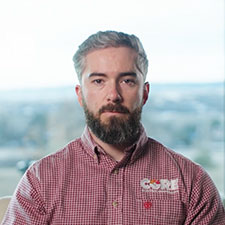
Jordan Ambrogi
Wildfire Mitigation Manager, CORE Electric Cooperative
-
How Bear Valley Electric Service Protects a High-Risk Territory with Dynamic Wildfire Intelligence
Bear Valley Electric Service serves a 32-square-mile territory located entirely within a California High Fire Threat District, where precise, timely intelligence is essential. Technosylva’s dynamic wildfire analytics replaced static risk models and gave BVES the circuit-level decision making their environment demands. This demonstrates how small, capable teams can rely on proven science to protect communities and strengthen resilience in high-risk environments.
“Technosylva’s platform allows us to be surgical in our operations while providing public safety and minimizing impacts on our customers.”

Paul Marconi
President, Bear Valley Electric Service
-
3 Ways Executives Can Stay Ahead of Wildfire Risk
Just knowing your service area’s wildfire risk is not enough anymore.
Wildfire risk has moved to the top of the agenda for electric utility executives across the country. The liability exposure is real, the regulatory expectations are rising, and the financial consequences of an asset-caused ignition have been made visible in ways that are difficult to ignore. For many executives, the challenge is not recognizing the risk. It is knowing where to focus and how to demonstrate that the organization is managing it with the rigor that insurers, credit agencies, regulators, and boards are now expecting.
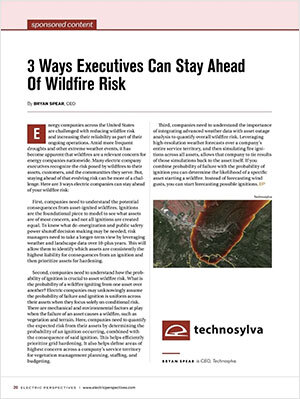
Technosylva CEO Bryan Spear addressed this directly in a piece for Electric Perspectives Magazine, laying out three ways electric company executives can move from a reactive posture to one that is genuinely ahead of their wildfire exposure. The argument is straightforward: wildfire risk is not like other natural hazard risks, and managing it well requires a different kind of analytical foundation.
Why Wildfire Risk Is Different
For most natural hazards, utility risk management focuses on outage restoration and revenue impact. The models are relatively well understood. Wildfire is different because the question is not just whether an outage will occur, but whether an asset failure will cause an ignition, and if it does, what the consequences of that ignition will be for communities, infrastructure, and the utility itself.
That combination of ignition probability and consequence is what makes wildfire risk genuinely complex to quantify, and what makes a generalized or static risk assessment insufficient for the conversations executives are now being asked to have with external stakeholders.
Three Ways to Get Ahead of It
The first is understanding the potential consequences of asset-ignited wildfires. As Bryan writes, ignitions are the foundational piece to model, and not all ignitions are created equal. To understand what de-energization and Public Safety Power Shutoff (PSPS) decision-making may be needed, risk managers need to take a longer-term view by leveraging weather and landscape data over ten or more years. That analysis identifies which assets are consistently the highest liability for consequences from an ignition, and allows executives to prioritize those assets for hardening based on actual potential impact rather than general proximity to risk.
The second is understanding how ignition probability varies across the asset base. Electric companies may unknowingly assume that the probability of failure and ignition is uniform across their assets when they focus solely on conditional risk. In reality, as Bryan notes, there are mechanical and environmental factors at play when the failure of an asset causes a wildfire, including vegetation and terrain. Quantifying the expected risk from assets by combining the probability of an ignition occurring with the consequence of that ignition helps efficiently prioritize grid hardening. It also defines areas of highest concern across a service territory for vegetation management planning, staffing, and budgeting.
The third is integrating advanced weather data with asset outage analysis to build a comprehensive view of overall wildfire risk. By leveraging high-resolution weather forecasts across the entire service territory and simulating fire ignitions across all assets, an organization can tie the results of those simulations back to the asset itself. As Bryan puts it: if you combine probability of failure with the probability of ignition, you can determine the likelihood of a specific asset starting a wildfire. Instead of forecasting wind gusts, you can start forecasting possible ignitions.
What This Means for Executives at Any Size Utility
The three capabilities Bryan describes are relevant for utility executives regardless of the size of their organization. A catastrophic asset-caused ignition carries existential consequences for a small cooperative or municipal utility just as it does for a large investor-owned utility. The financial exposure, the regulatory scrutiny, and the community impact do not scale down with the size of the organization.
What does vary is the internal analytical capacity to build and maintain this kind of modeling framework. The regulatory and financial expectations Bryan describes apply across utility sizes, and the path to meeting them looks different depending on the organization.
The executives best positioned to manage wildfire risk going forward are not necessarily the ones with the largest budgets. They are the ones who understand their specific exposure at the asset level, can quantify the consequences of their highest-risk ignition scenarios, and can communicate that understanding clearly to the stakeholders who are asking.
Read Bryan’s full piece in Electric Perspectives Magazine for the complete argument.

-
Put Your Wildfire Risk into Context
Electric companies need to leverage a comprehensive understanding of their asset wildfire risk to plan for a safer future. With applied technology, they can reconstruct past fire seasons to truly define outlier events and model the consequences of asset-caused ignitions to identify trends and patterns that better prepare them for future wildfire risks. A shifting regulatory and legal landscape around wildfire liability is requiring electric companies to think differently about risk.
“Attempting to forecast wildfire risk without using past events as a baseline is like analyzing a single data point without any reference.“

Attempting to forecast wildfire risk without using past events as a baseline is like analyzing a single data point without any reference. Technosylva’s Senior Data Scientist, Pavel Grechanuk, discussed in Electric Perspectives Magazine the importance of using the data of historical fire seasons to prepare for future extreme weather events. He emphasizes that electric companies must not only analyze simulated wildfire consequences, but also understand the likelihood of their assets igniting wildfires. By constructing dynamic models and analyzing past events, electric companies can gain a comprehensive understanding of their assets’ wildfire risk.
This approach allows for proactive measures to be taken across operations and mitigation to address the impact of future extreme weather events. The use of historical data also allows for the identification of trends and patterns, providing valuable insights into where the risk of wildfire and its impacts to communities truly exists across an electric company’s service area. By understanding the expected risk from their assets across a historic timeline view of “unprecedented” outliers, utilities can efficiently prioritize grid-hardening and mitigation efforts, making the best use of their limited budget resources and regulatory processes.
Furthermore, by contextualizing future events with a robust database of historical risks, electric companies can effectively monitor the frequency and intensity of weather events and identify specific assets along their lines that will be most impacted by climate change. This proactive approach to risk management not only ensures the safety of assets and communities, but also helps in minimizing the potential consequences of asset-caused wildfires.
Learn how you can predict, mitigate, and prevent your evolving wildfire risk and additionally, how Technosylva solutions provide leading electric utilities with increased risk management, operations, asset mitigation, emergency planning, regulatory compliance, and improved public safety.
You can read the full article in Electric Perspectives Magazine here.
-
3 Keys to Averting Tomorrow’s Black Swan Natural Catastrophe

“Forecasts show the weather. Climatology shows the why behind the risk.”
Why Electric Utilities Must Move Beyond Forecasts to Climatological Foresight
Electric utilities today face a growing and unpredictable threat: the Black Swan event — a rare but devastating natural catastrophe that can cripple infrastructure and disrupt entire communities. As wildfires and extreme weather events become more frequent and intense, relying solely on traditional weather forecasts is no longer enough.
In a recent Utility Dive piece, Steve Vanderburg, Technosylva’s Vice President for Weather & Risk Solutions, explored how electric utilities can better anticipate and mitigate these high-impact events. Drawing from his experience across government and electric utility roles, he emphasizes the critical need for electric utilities to incorporate climatology, the study of long-term weather patterns, into their risk management strategies.
Here are 3 key takeaways for electric utilities aiming to future-proof their grid
- Forecasts show the weather. Climatology shows the why behind the risk
Traditional weather forecasting tells you what’s coming. But without the context of historical weather extremes, it’s hard to know whether an event is routine or unprecedented. Understanding that a wind event, for example, is in the 99.5th percentile of past data can change the entire response strategy. - Climatology reveals anomalies — and that’s where Black Swans hide.
Wildfires in regions with little prior history, like Oregon’s 2020 Labor Day fires, show how fast the risk landscape can shift. Localized climatological modeling can identify those rare but high-impact scenarios before they happen. - Local fire weather behavior is key to smarter decisions.
A 40 mph gust isn’t the same everywhere. Trees in wind-sheltered zones respond differently than those accustomed to strong gusts. Understanding these localized dynamics helps set better thresholds for action and improve operational resilience.
By understanding the historical climatological context of their service areas, electric utilities can better identify anomalies in current weather patterns and shift from reactive responses to proactive risk mitigation. That means greater accuracy, earlier warnings and a stronger, resilient grid.
Read his full article in Utility Dive to learn how electric utilities are leveraging climatology, ignition modeling, wildfire spread predictions, and impact analysis to forecast risk days in advance. See how leading electric utilities are applying these tools like weather forecasts, ignition models, on-demand wildfire spread predictions, in practice to forecast & monitor wildfire risks before disaster strikes.
- Forecasts show the weather. Climatology shows the why behind the risk
-
Your Guide to Wildfire Risk and Liability Exposure
This webinar discusses understanding current trends in wildfire behavior and their implications on risk and liability exposure, along with methodologies for risk assessment, mitigation strategies, and tools for real-time monitoring and response to wildfire threats.
Duration: 1 hour
This informative webinar, in collaboration with Utility Dive, explores the tactics utilized by leading electric utilities to forecast, mitigate, and respond to wildfire risks and the associated liability.
As wildfires continue to increase in frequency and severity, they present a significant threat to electric utilities infrastructure and communities. Electric utilities face a risk stemming from their infrastructure to trigger wildfires and the liabilities that come with that.
Electric utilities can adopt proactive measures, such as preemptive power shutdowns to minimize the risk of wildfires and safeguard the areas in their service territory as well as using solutions that can help assess assets for mitigation purposes.
During the session, you will learn from Technosylva:
- Insights into the latest trends and patterns in wildfire behavior, and their implications for risk and liability exposure
- Methodologies for assessing wildfire risk and strategies for implementing effective mitigation measures
- Tools and techniques for real-time monitoring and response to wildfire threats
Speakers
David Buckley
Board Advisor
TechnosylvaScott Purdy
Meteorological Analyst
Technosylva -
Electric Company Combating Wildfires with Better Technology
Hear from the CEO of PG&E, Patti Poppe, as she explains to Bloomberg News how technology is helping PG&E combat risk the of wildfire through advanced modeling, strengthened situational awareness, and improved decision making for asset hardening.
“Last year we had a 68% reduction in ignitions as a result of our layers of protection, resulting in a 99% reduction in acres burned in one of the very driest years that we had on record. Very tough conditions. So heading into this year, we know we have that technology armed and able to address whatever the conditions are.”

Patti Poppe
CEO, PG&E