Article
6 Pillars of Wildfire Resilience for Electric Utilities

Wildfire risk has become a year-round planning consideration for electric utilities across the country. Longer fire seasons, shifting weather patterns, and growing regulatory expectations have made wildfire resilience a core part of long-term grid strategy. For utilities building or refining that strategy, it helps to think across six interconnected areas. Gaps in any one of them can limit the effectiveness of investments made in the others.
1. Identifying and Prioritizing Threats
Effective wildfire mitigation starts with knowing which assets carry the most risk and why. That requires more than a static risk assessment. Ignition probability varies across assets based on equipment age, conductor type, span length, vegetation conditions, terrain, and local weather patterns. Consequence varies too, depending on what lies in a fire’s potential path.
Integrating these factors through risk modeling allows utilities to move from broad hazard zones to asset-level prioritization. That specificity matters when hardening budgets are limited and every dollar needs to be directed where it will produce the most meaningful reduction in expected risk.
2. Maintaining Service During Extreme Events
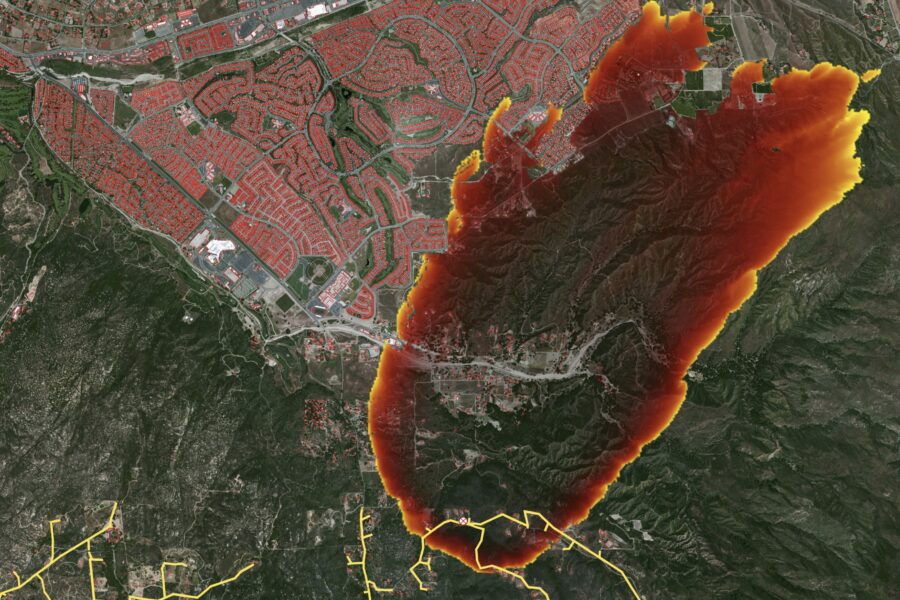
Operational resilience during a wildfire event depends on having accurate, real-time information about how fire is behaving relative to grid infrastructure. Operators making decisions about de-energizing lines, rerouting power, or deploying crews need more than weather forecasts. They need visibility into how fire spread is likely to interact with specific assets under current and forecasted conditions.
For planners at utilities of any size, the design question is what information and decision-support tools need to be in place before an event occurs. Operational gaps during an active fire are difficult to close in the moment.
3. Measuring the Impact of Investments
Utilities invest in vegetation management, infrastructure hardening, and other mitigation activities at varying scales. Demonstrating the risk reduction those investments produce is increasingly important, both for internal planning and for regulatory and stakeholder accountability.
Analysis that compares pre- and post-mitigation conditions, and models fire behavior in treated versus untreated areas, allows utilities to quantify what their investments have accomplished. That evidence base also informs future prioritization by showing where mitigation has been most effective and where diminishing returns may be setting in.
4. Responding Effectively to Wildfire Events
Emergency response plans are most effective when they are built on realistic modeling of how fires behave and how infrastructure responds under stress. Scenario-based planning, informed by fire spread prediction, helps utilities anticipate where resources will be needed and how response timelines are likely to unfold.
From a planning perspective, emergency response capability is partly a function of decisions made well in advance: where crews are positioned, what mutual aid agreements are in place, and how communication protocols are structured before an event begins.
5. Meeting and Exceeding Evolving Regulatory and Stakeholder Requirements
The regulatory environment around wildfire safety continues to evolve, with utilities in higher-risk areas facing increasingly detailed reporting and documentation requirements. Tracking mitigation activities, documenting risk assessments, and generating compliance reports are resource-intensive tasks regardless of utility size.
Building organized, consistent documentation practices early makes compliance more manageable and ensures that reporting reflects the same risk information driving planning and operational decisions. For utilities entering more regulated environments, getting that foundation in place before requirements intensify reduces the burden of catching up later.
6. Protecting Communities and Workers in the Field
Field crew safety and public protection are the ultimate measure of a wildfire resilience program. Real-time visibility into fire hazards, weather conditions, and infrastructure vulnerabilities supports better decisions about when and where to deploy personnel and when to communicate proactively with the public.
Safety outcomes are shaped by the quality of information available at the moment decisions are made. That makes investment in situational awareness a safety consideration as much as an operational one, and one that scales to the resources available.
Building a Connected Strategy
These six areas are most valuable when they are treated as connected parts of a single strategy rather than separate programs. Risk assessment informs investment prioritization. Investment measurement feeds back into planning. Operational capability depends on the information foundations built during non-event periods. Regulatory compliance is easier to sustain when it is integrated into existing workflows rather than managed separately.
For utilities of any size building long-term wildfire resilience, the goal is a strategy where progress in each area reinforces the others.
Related Posts